Smart Water Leak Detection & Automatic Shut-Off System

Smart Water Leak Detection & Automatic Shut-Off System

Detect Slow Leaks. Stop Burst Hose Pipes. Save Water Automatically.

FlowShield is a smart water leak monitoring system that detects abnormal continuous water flow, slow leaks, burst hose pipes, and unattended taps — then automatically shuts off the water supply to help prevent water damage and water wastage.

Prevent Water Damage Before It Becomes Expensive

Water leaks can happen anytime — at night, during office closure, over the weekend, or while you are away on holiday.

A bidet hose may burst. A flexible pipe may fail. A water tap may be left slightly open. A valve may not be completely turned off. When nobody is around, water can continue flowing for hours or even days.

FlowShield is designed as a practical water leak detection system with automatic water shut-off. It helps protect homes, offices, rental units, toilets, pantries, shops, and facility zones from unnecessary water loss and water damage.

Common Water Leak Problems

Common Causes

  • Burst bidet hose
  • Water tap not fully turned off
  • Valve not completely closed
  • Toilet cistern leaking continuously
  • Faulty flush valve
  • Worn flexible hose
  • Loose pipe connection
  • Pantry tap left running
  • Washing machine hose failure
  • Water dispenser slow leak

Possible Damage

  • Unnecessary water wastage
  • Flooded toilets, kitchens, pantries, or service areas
  • Damaged cabinets, flooring, walls, and ceilings
  • Leakage to lower floors
  • Expensive repair work
  • Complaints from neighbours or tenants
  • Business interruption
  • Facility maintenance headaches

More Than a Basic Water Leak Alarm

A normal water leak alarm usually detects water only after it has reached the floor. By then, the water may already be spreading.

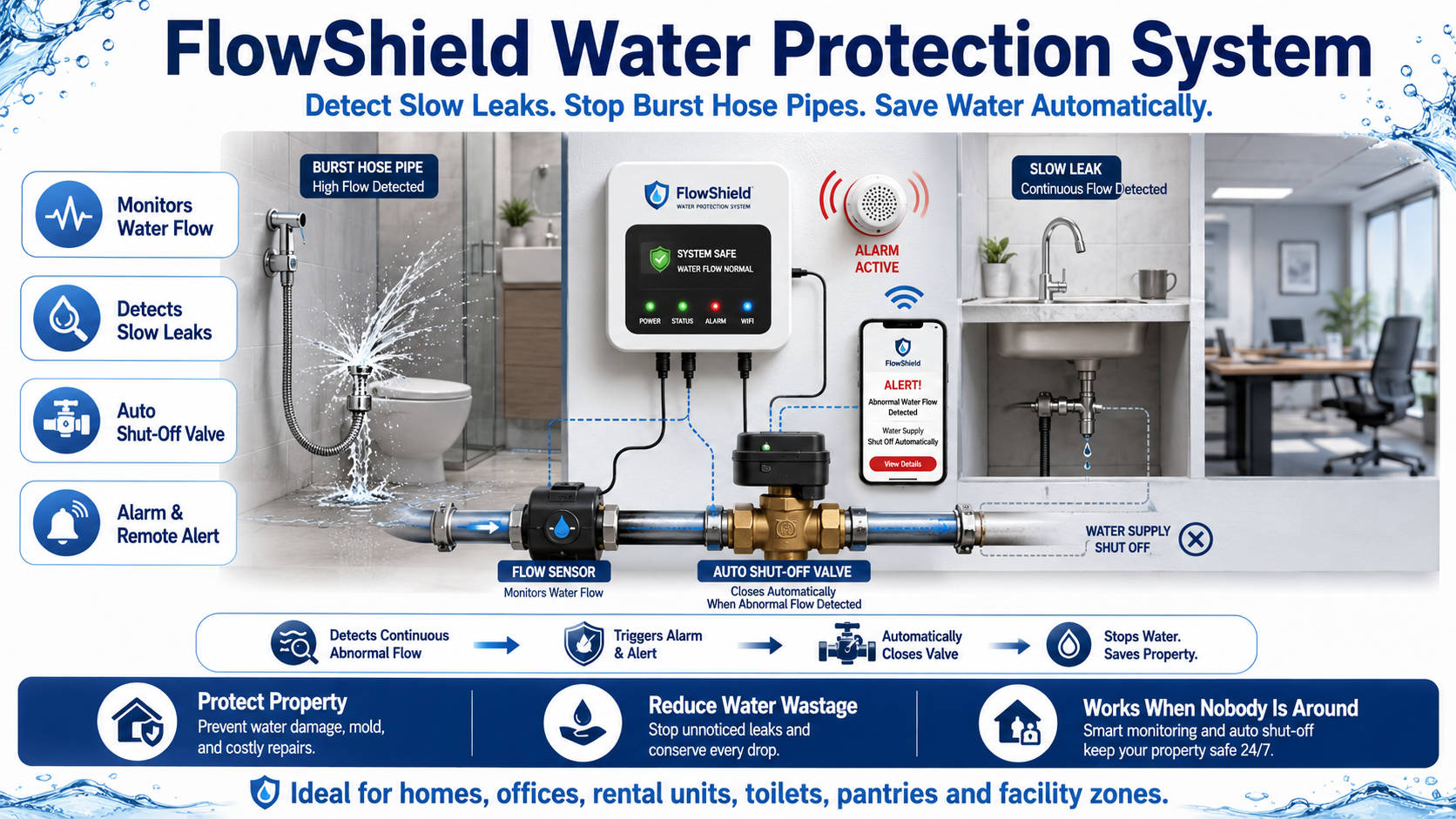
FlowShield works differently. It monitors the water supply line using a water flow sensor. When the system detects abnormal continuous water flow, it can trigger an alert and automatically close the shut-off valve.

If water keeps flowing continuously beyond the preset timing, FlowShield treats it as a possible leak, burst hose pipe, unattended tap, or faulty valve — and shuts off the water supply automatically.

Detects Slow Leaks and Burst Hose Pipes

Not all water leaks are the same. Some leaks happen suddenly with high water flow. Some leaks are small, slow, and easy to miss.

FlowShield can be configured to detect both fast leak events and slow continuous leak events by monitoring water flow rate and continuous flow duration.

Fast Leak Detection

High-flow leakage can waste a large amount of water quickly and cause serious damage.

  • Burst bidet hose
  • Broken pipe
  • Fully opened tap
  • Failed flexible hose
  • Pipe joint failure
  • Toilet hose bursting

Slow Leak Detection

Small continuous leaks may look harmless, but they can waste water for many hours if nobody notices.

  • Tap not fully turned off
  • Valve not completely closed
  • Toilet cistern slowly leaking
  • Flush valve not sealing properly
  • Bidet spray slightly dripping
  • Small pipe joint seepage
  • Water dispenser slow leak

How the Automatic Water Shut-Off System Works

1. Monitors Water Flow

A water flow sensor is installed on the water supply line to detect water movement through the pipe.

2. Measures Flow Duration

The electronic controller checks how long the water has been flowing continuously and compares it with the preset timing.

3. Detects Abnormal Usage

If the water keeps flowing for too long, the system identifies it as a possible leak, burst pipe, or unattended tap.

4. Closes the Water Valve

The automatic shut-off valve closes the water supply to stop further leakage and water wastage.

5. Sounds Alarm or Sends Alert

A local buzzer, LED indicator, or remote notification can alert the homeowner, office, or maintenance team.

6. Reset After Inspection

After the problem is checked and corrected, the user can press a reset button to restore normal operation.

Configurable Water Leak Monitoring

Every location has a different water usage pattern. FlowShield can be configured based on the expected usage of the area.

Area TypeExample Trigger SettingPurpose
Toilet Area10 minutesDetect unattended taps, burst bidet hoses, and abnormal toilet water usage
Home Use30 minutesGeneral protection against leaks, burst hoses, and forgotten taps
Pantry or Utility Area60 minutesAllow longer normal usage while still detecting abnormal continuous flow
Commercial or Facility AreaCustom timingAdjust based on site operation and water usage behaviour

For high-usage public areas, the system can also work with a human traffic sensor or occupancy sensor to help differentiate normal heavy usage from unattended water leakage.

Suitable for Homes, Offices, Rental Units and Facilities

FlowShield can be used as a home water leak detection system, an office water leak monitoring system, or a facility water leak prevention system.

Homes and Apartments

Protect against burst bidet hoses, leaking toilets, unattended taps, and water pipe failures while the family is asleep or away.

Small Offices

Monitor toilets, pantries, utility rooms, and cleaning points after office hours.

Rental Properties

Reduce the risk of unattended water damage caused by tenants, worn fittings, or forgotten taps.

Shops and Commercial Units

Protect premises during non-operating hours, weekends, and public holidays.

Schools, Hostels and Dormitories

Monitor washrooms, common toilets, pantries, and shared utility areas.

Factories and Warehouses

Deploy protection in selected water supply zones without shutting down water to the entire building.

Zone-Based Water Shut-Off Protection

For buildings and facilities, multiple FlowShield units can be installed strategically in different zones. This allows the system to isolate only the affected area instead of cutting off water to the entire building.

  • One unit for each toilet
  • One unit for each pantry
  • One unit for each rental room
  • One unit for each office floor
  • One unit for each building section
  • One unit for each high-risk water point

This makes FlowShield suitable for facility water leak monitoring, remote water leak alert, and selected-area automatic water shut-off applications.

Timer-Based Monitoring for Night, Weekend and Holiday Protection

Some locations have normal water usage during the day but very little usage at night. FlowShield can be configured to monitor more actively during selected periods.

  • Night monitoring from 10:00 pm to 7:00 am
  • After-office-hours monitoring
  • Weekend protection mode
  • Holiday protection mode
  • Special closure period monitoring

This is useful for homes, offices, shops, schools, dormitories, and facilities where water leakage may go unnoticed during non-operating hours.

Key Benefits of FlowShield

  • Automatic water shut-off when abnormal continuous flow is detected
  • Slow leak detection for taps, valves, cisterns, and small pipe seepage
  • Burst hose pipe protection for bidet hoses and flexible water hoses
  • Water damage prevention for homes, offices, and facilities
  • Remote water leak alert option for responsible personnel
  • Zone-based protection to isolate only the affected area
  • Configurable timing for different water usage patterns
  • Low-power monitoring for continuous protection

Smart Water Leak Detection Features

Depending on the application, FlowShield can support the following features:

  • Water flow monitoring
  • Continuous flow timing
  • Low-flow leak detection
  • Burst pipe and burst hose detection
  • Automatic shut-off valve control
  • Manual reset button
  • Local buzzer alarm
  • LED status indication
  • Remote notification option
  • Control office alert option
  • Night mode monitoring
  • Weekend and holiday monitoring
  • Human traffic sensor input option
  • Zone-based deployment
  • Flow event logging option
  • Building management integration option

Flow-Based Detection vs Floor Leak Sensors

Floor leak sensors are useful, but they only detect water after it reaches the sensor location. If water flows in another direction, the leak may not be detected immediately.

FlowShield detects abnormal water usage from the water supply line itself. This helps identify possible leaks before water spreads across the floor.

This makes FlowShield especially useful for toilets, pantries, under-sink areas, concealed areas, service rooms, rental rooms, and unattended premises.

Example Scenario: Burst Bidet Hose at Night

A bidet hose bursts at 2:00 am. Without protection, water may continue flowing for hours until someone wakes up or returns to the premises.

  1. FlowShield detects continuous water flow
  2. The controller starts measuring the flow duration
  3. The flow continues beyond the preset timing
  4. The automatic water shut-off valve closes
  5. A local alarm sounds or remote notification is sent
  6. Water wastage and damage are reduced
  7. The user resets the system after inspection

Example Scenario: Tap or Valve Not Fully Turned Off

A tap or water valve is not completely closed after use. Only a small amount of water continues flowing, so nobody notices immediately.

Without monitoring, this small leak may continue overnight or during a long holiday period.

  1. FlowShield detects small continuous water flow
  2. The controller monitors the flow duration
  3. The system identifies abnormal long-duration water usage
  4. An alert or automatic shut-off is triggered
  5. Water wastage is stopped

Simple System Components

Water Flow Sensor

Detects water movement through the pipe and helps identify continuous water flow conditions.

Electronic Monitoring Controller

Measures water flow duration and determines whether the flow pattern is normal or abnormal.

Automatic Shut-Off Valve

Closes the water supply when a leak, burst hose, or abnormal continuous flow condition is detected.

Alarm and Status Indicator

Provides local warning and system status indication when the system detects abnormal water flow.

Reset Button

Allows the user to reset the system after checking and correcting the leakage condition.

Optional Remote Alert Module

Sends notification to the homeowner, tenant, maintenance team, security office, or control room.

Comparison: Basic Water Leak Alarm vs FlowShield

FeatureBasic Water Leak AlarmFlowShield Water Protection System
Detects water on floorYesOptional
Detects continuous water flowNoYes
Detects slow continuous leaksNoYes
Detects burst hose pipe conditionLimitedYes
Automatically shuts off waterNoYes
Works before water spreads on floorNoYes
Suitable when nobody is aroundLimitedYes
Supports zone-based protectionNoYes
Can send remote water leak alertSome modelsYes
Helps save waterLimitedYes

Frequently Asked Questions

Can this system detect a small water leak?

Yes. The system can be configured to detect small continuous water flow, such as a tap not fully turned off, a valve not completely closed, or a toilet cistern slowly leaking.

Can it stop a burst bidet hose?

Yes. If a bidet hose or flexible hose bursts and water keeps flowing continuously beyond the preset timing, the system can automatically shut off the water supply.

Will normal water usage trigger the shut-off?

Normal short water usage should not trigger the shut-off. The system is based on abnormal continuous water flow duration and can be adjusted according to the location.

Can this be used in offices or commercial facilities?

Yes. FlowShield can be deployed in toilets, pantries, service rooms, rental rooms, office floors, and facility zones. Multiple units can be installed to isolate only the affected area.

Can it send remote alerts?

Yes. An optional remote alert module can notify a homeowner, tenant, security office, maintenance team, or control room when abnormal water flow is detected.

Protect Your Property Before the Next Water Leak Happens

Water leaks are unpredictable. They can happen while you sleep, while your office is closed, or while nobody is around.

FlowShield gives you a practical layer of protection against slow leaks, burst hose pipes, unattended taps, and abnormal continuous water flow.

Detect Slow Leaks. Stop Burst Hose Pipes. Save Water Automatically.

Controller for Electrode Water Sensor Rods

Water Tank Level sensor controller

Choosing the Right Controller for PS-5R Water Level Sensor Rods

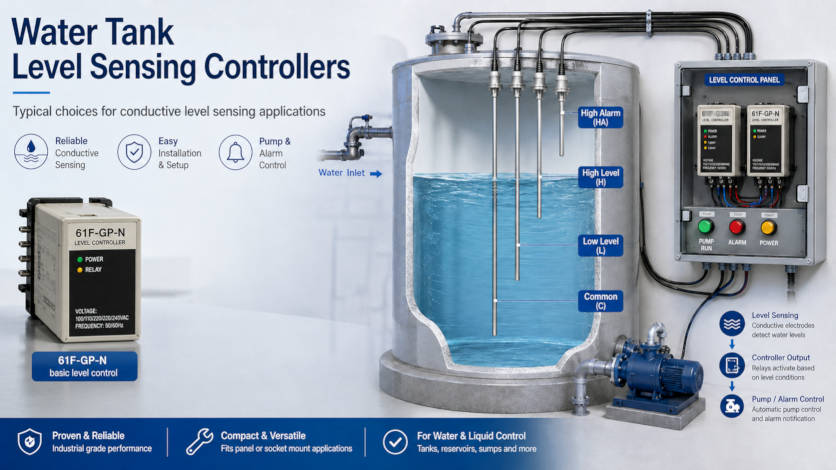
The PS-5R electrode holder is used together with a conductive / floatless water level controller. The electrode rods detect water contact, while the controller converts that signal into relay output for pump control, high level alarm, low level alarm, or level indication.

✓ Water tank level sensing

✓ Pump control

✓ High / low level alarm

✓ Conductive liquid sensing

PS-5R Is the Sensor Holder — The 61F Is the Controller

A common misunderstanding is to treat the PS-5R as a complete water level sensor system. In actual use, the PS-5R is the electrode holder and rod assembly. It needs a compatible controller such as the Omron 61F series to operate the relay output.

1. Electrode Holder

PS-5R

Holds up to 5 electrode rods. The rods are cut to different lengths according to the required water levels.

2. Controller

61F Series

Detects the conductive path through water and provides relay output for control, alarm, or indication.

3. Output Device

Pump / Alarm

The controller output can drive a contactor, pump starter, alarm lamp, buzzer, PLC input, or BMS input.

Most Common Controller Choices

For most PS-5R water level applications, customers usually choose between a basic controller such as 61F-GP-N and a multi-level controller such as 61F-G3N.

Basic Level Control

61F-GP-N

Choose this when you only need simple water level control, such as pump ON/OFF between two levels or a single high/low level alarm.

  • Suitable for simple tank level control
  • Good for 1 or 2 level points
  • Compact plug-in type controller
  • Common choice for basic pump start/stop applications
  • Cost-effective for simple control panels

Multi-Level Control + Alarm

61F-G3N

Choose this when you need pump control together with high and low water level alarm points. This is usually the better choice for fire water tanks, service tanks, and applications where multiple level signals are required.

  • Suitable for multiple level points
  • Can support pump control plus high/low level alarms
  • Cleaner setup than using multiple basic controllers
  • Recommended for 3-level fire water tank monitoring
  • Better for control panels with alarm outputs

61F-GP-N vs 61F-G3N: Which One Should You Use?

Selection Point61F-GP-N61F-G3N
Best forSimple level control Pump control with high / low alarm
Typical number of level points1 or 2 level points3 or more level functions depending on wiring and application
Typical applicationBasic tank full/empty control, pump start/stop, simple high or low alarmFire water tank, service water tank, refill tank, tank with high alarm and low alarm
When to chooseChoose when the customer only needs basic pump ON/OFF or one simple alarm outputChoose when the customer needs more complete monitoring, such as high level, refill control, and low level alarm
Panel designSmaller and simpler panel. Suitable for basic applicationsMore complete control panel. Suitable when alarm points must be clearly separated
Recommended for PS-5R?Yes, for simple applications using only some of the rodsYes, especially when using PS-5R for multi-level monitoring
Simple recommendationUse this for basic tank controlUse this for fire water tank / 3-level monitoring

Typical 3-Level Fire Water Tank Setup

For a fire water tank, a typical setup uses one common electrode and several level electrodes. The common electrode is normally the longest rod. The other rods are cut to the required alarm and control levels.

Electrode LevelFunctionTypical Action
High AlarmDetects overfill or high water conditionTrigger high level alarm, indicator lamp, BMS input, or alarm panel input
Stop RefillNormal full levelStop refill pump or close inlet valve
Start RefillNormal low operating levelStart refill pump or open inlet valve
Low AlarmLow water reserve warningTrigger low level alarm, fire alarm monitoring input, or BMS input
Common ElectrodeReference electrodeUsually the longest rod, extending below the lowest detection point

Practical recommendation: For a 3-level fire water tank application, use the PS-5R electrode holder together with a multi-level controller such as 61F-G3N. This gives a cleaner solution for refill control plus high and low level alarm.

How to Select the Correct 61F Controller

Step 1: Count the Required Levels

If you only need simple pump ON/OFF, 61F-GP-N is usually enough. If you need high alarm, normal control, and low alarm, use 61F-G3N.

Step 2: Check Cable Distance

If the tank is far from the control panel, a long-distance version may be required. This is important for rooftop tanks, remote tanks, and large facilities.

Step 3: Check Water Conductivity

Conductive level controllers require the liquid to conduct electricity. Normal tap water is usually suitable, but very clean or low-conductivity water may need a high-sensitivity model.

Other 61F Variants You May See

Besides the normal general-purpose models, 61F controllers may also come in special versions depending on site conditions.

Variant TypeMeaningUse When
General-purposeStandard model for normal conductive water level controlNormal tap water, tank control, refill pump control
Long-distance typeDesigned for longer wiring distance between tank electrodes and controllerTank is far away from the control panel
High-sensitivity typeMore sensitive detection for lower-conductivity liquidClean water, rainwater, purified water, or weakly conductive liquid
Low-sensitivity typeLess sensitive to leakage current, condensation, foam, or wet cable pathsNoisy environments or sites with false triggering problems
Two-wire typeSpecial wiring method for reducing electrode wiringUse only when matched with the correct two-wire electrode holder / application

Quick Recommendation

Choose 61F-GP-N if…

  • You need simple water level control.
  • You only need pump ON/OFF between two levels.
  • You only need one high or low level alarm.
  • You want a compact and cost-effective controller.

Choose 61F-G3N if…

  • You need 3-level water tank monitoring.
  • You need pump control plus high and low alarms.
  • You are monitoring a fire water tank or service water tank.
  • You want a cleaner solution than using multiple basic controllers.

Important note for fire water tanks: Fire water tank alarm and control requirements may be subject to project specifications, local authority requirements, fire code requirements, and licensed fire protection contractor approval. Always confirm the final control logic and alarm connection with the project consultant or qualified contractor.

Need Help Choosing the Correct Water Level Controller?

Tell us your tank application, number of level points, cable distance, water type, and required output such as pump control, high level alarm, low level alarm, PLC input, or BMS input. We can help recommend a suitable controller setup for use with PS-5R electrode rods.

Executive Protocol

Executive Protocol, also known as EXE, Exec or Protocol A, is one of the classic communication standards used between vending machines and payment systems. It is especially well known in Europe and is still commonly found in older vending machines, particularly in markets such as Italy, France and Spain.

What Is Executive Protocol?

Executive Protocol is a vending machine communication protocol used to connect the vending machine controller with payment devices such as coin mechanisms, change givers and payment controllers. It was originally developed as a proprietary protocol by Mars Electronics International, also known as MEI, and became widely adopted in the vending industry.

In many vending machine installations, Executive Protocol is used to manage payment credit, product pricing, vend authorisation and communication between the vending machine and the payment system.

Simple explanation: Executive Protocol is the communication language used by some vending machines and payment systems to decide when enough money has been inserted and whether the machine should allow a product to be dispensed.

Common Names for Executive Protocol

Depending on the machine manufacturer, payment system supplier or technical manual, Executive Protocol may be referred to using different names.

The full name commonly used in vending machine manuals and payment system documentation.

EXE / Exec

Short form used by many vending technicians and machine suppliers.

Protocol A

An alternative technical name often associated with MEI / Mars payment system documentation.

Why Executive Protocol Is Important

Executive Protocol remains important because many vending machines in Europe were designed around this payment interface. While newer machines often use MDB, there are still many machines in the field that continue to use Executive Protocol.

This is especially relevant when upgrading an older vending machine with modern payment systems such as cashless card readers, QR payment terminals, telemetry devices or remote monitoring systems.

  • It is widely used in older European vending machines.
  • It is commonly associated with Italian vending machines.
  • It is often found in machines using older coin mechanisms or payment controllers.
  • It may require an adapter when connecting to modern MDB-based cashless systems.
  • It is useful to understand when repairing, retrofitting or upgrading vending machines.

Executive Protocol in Europe and Italy

Executive Protocol is commonly found in European vending machines, especially in countries such as Italy, France and Spain. In the Italian vending industry, Executive Protocol has historically been very popular, and many technicians consider it one of the dominant protocols used in older Italian vending machines.

Industry observation: It is often said within the vending industry that a very high percentage of Italian vending machines use Executive Protocol, with some estimates claiming around 90%. The exact percentage can vary depending on machine age, manufacturer, location and whether the machine has been upgraded to MDB or cashless payment systems.

For this reason, anyone working with Italian vending machines, imported European machines or older coffee and snack vending machines may need to understand Executive Protocol.

Executive Protocol vs MDB

Executive Protocol and MDB are both vending machine payment communication protocols, but they are not the same. MDB is now more common in modern vending machines, while Executive Protocol is more commonly associated with older European vending systems.

FeatureExecutive ProtocolMDB Protocol
Common NameExecutive, EXE, Exec, Protocol AMDB, Multi-Drop Bus
Typical UsageOlder vending machines, especially in EuropeModern vending machines worldwide
Common RegionEurope, especially Italy, France and SpainGlobal vending market
Payment System RoleThe payment system has a strong role in controlling vend credit and permissionThe vending machine controller usually acts as the main controller and polls MDB devices
Cashless UpgradeMay require an Executive-to-MDB adapter or compatible cashless deviceUsually easier to connect to modern card readers, QR payment terminals and telemetry systems
Best ForMaintaining or upgrading older European vending machinesNew vending machine designs and modern cashless payment integration

Is Executive Protocol Open Source?

Executive Protocol was originally created as a proprietary vending machine protocol. Over time, as the protocol became widely used and many older machines remained in service, information about the protocol became more accessible to technicians, payment system suppliers and vending machine developers.

Today, Executive Protocol is often treated as an open or publicly documented legacy protocol in practical vending machine work. This makes it possible for repairers, retrofitters and equipment developers to support older machines that still rely on Executive communication.

Important note: “Open source” and “open protocol” are not always the same thing. Executive Protocol is better described as a widely documented legacy vending protocol rather than software source code. When developing commercial equipment, always check the actual protocol specification, electrical interface and any relevant compliance requirements.

MDB to Executive Protocol Converter

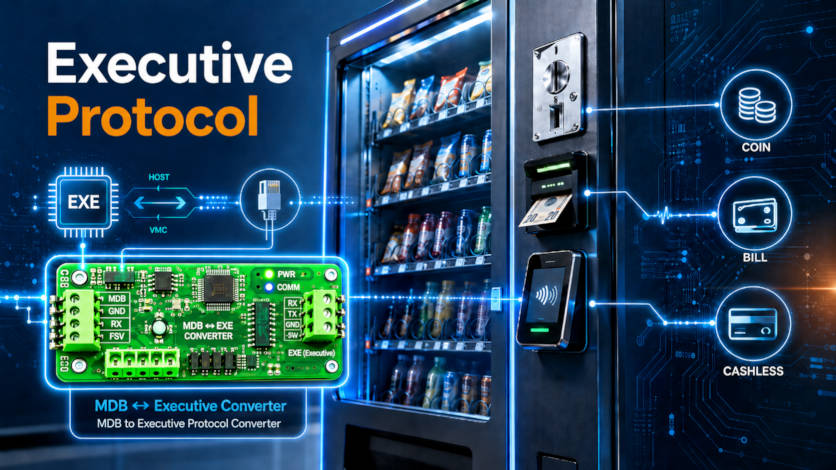
One common challenge is connecting modern MDB-based payment devices to older vending machines that use Executive Protocol. In this situation, an MDB to Executive Protocol converter can be used as an interface between the modern payment system and the older machine.

A converter board may translate communication between MDB and Executive Protocol, allowing the vending machine to work with newer cashless payment terminals, card readers, QR payment systems or telemetry devices.

  • Connects modern MDB payment devices to older Executive vending machines.
  • Translates payment credit and vend authorisation signals.
  • Helps extend the useful life of older European vending machines.
  • Allows upgrade paths for cashless payment and remote monitoring.
  • Can be useful for vending machine retrofit and repair projects.

When Do You Need Executive Protocol?

You may need Executive Protocol knowledge when working with vending machines that do not support MDB directly, or when the existing payment system is based on Executive communication.

Common situations include:

  • Replacing an old coin mechanism in a European vending machine.
  • Adding a cashless payment terminal to an older machine.
  • Repairing an Italian coffee, snack or drink vending machine.
  • Connecting a telemetry system to a vending machine using Executive Protocol.
  • Building an adapter between Executive Protocol and MDB.
  • Developing a custom payment controller for older vending machines.

Executive Protocol Adapter and Upgrade Considerations

Many modern cashless payment devices are designed around MDB because MDB is widely supported in newer vending machines. If the vending machine only supports Executive Protocol, an adapter may be required.

The adapter may perform one of the following functions:

  • Convert Executive Protocol to MDB.
  • Allow an MDB cashless reader to work with an Executive vending machine.
  • Translate payment credit and vend commands between the two systems.
  • Provide compatibility between old vending machines and modern payment terminals.

Practical recommendation: For a new vending machine project, MDB is usually the better starting point. For supporting older European vending machines, Executive Protocol support can be added as a compatibility feature or through a dedicated adapter.

Technical Points to Check

Before connecting to an Executive Protocol vending machine, it is important to check the machine manual and payment system documentation. Different machines and payment systems may have different wiring, connector pinouts and configuration options.

  • Connector type and pinout
  • Voltage level and power supply requirement
  • Executive / EXE mode setting in the vending machine
  • Payment system compatibility
  • Vend price configuration
  • Credit handling and vend authorisation behaviour
  • Whether the machine supports MDB, Executive, BDV or multiple protocols

Summary

Executive Protocol is an important legacy vending machine communication standard. It is especially relevant in Europe and is commonly associated with Italian vending machines. Although MDB is now more common in modern vending machine designs, Executive Protocol is still important for servicing, upgrading and integrating payment systems with older machines.

For businesses working with vending machine payment systems, understanding Executive Protocol can help when upgrading old machines, adding cashless payment, troubleshooting coin mechanisms or designing protocol adapters.

Need Help with Vending Machine Payment Integration?

PIC-CONTROL can help with vending machine interface projects, including MDB, Executive Protocol, coin mechanisms, cashless readers, protocol converters and custom payment interface hardware.

Documentation

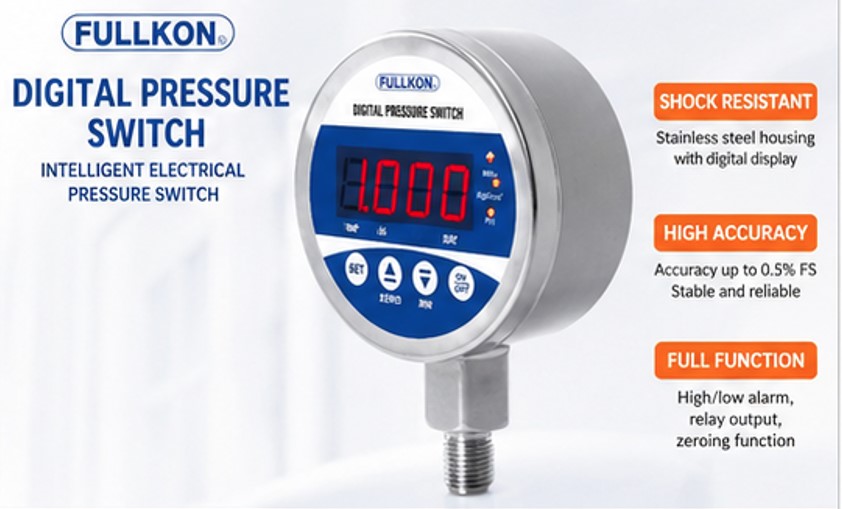
Pressure Switch

A pressure switch is a practical and reliable sensor used to monitor and maintain water pipe pressure in pumps, water systems, tanks, and piping installations. It helps detect pressure changes and automatically triggers connected equipment when the pressure reaches a preset pressure level.

We supply pressure switches suitable for industrial, commercial, and general water pressure control applications in Singapore.


What Is a Pressure Switch?

A pressure switch is a control device that responds to pressure in a pipe or system. When the water pressure rises or drops to a preset value, the pressure switch opens or closes an electrical contact.

This allows the switch to control pumps, alarms, indicators, or other equipment used to maintain safe and stable water pressure.

Common Applications

  • Water pump pressure control
  • Water pipe pressure monitoring
  • Booster pump systems
  • Water tank pressure systems
  • Industrial water piping
  • Building maintenance systems
  • Automatic pump start and stop control
  • Pressure safety monitoring

How It Helps Maintain Water Pipe Pressure

In a water pipe system, pressure may change due to pump operation, water usage, leakage, or system demand. A pressure switch helps monitor these changes and sends an electrical signal when the pressure reaches the preset value.

For example, when the pipe pressure drops below a certain level, the pressure switch can activate a pump. When the pressure reaches the desired level, the switch can stop the pump. This helps maintain consistent water pressure and protects the system from unnecessary pump operation.

Key Features

  • Reliable pressure sensing for water pipe systems
  • Suitable for pump control and pressure monitoring
  • Helps maintain stable water pressure
  • Can be used for automatic start and stop control
  • Compact and easy to install
  • Suitable for commercial and industrial applications
  • Available in different pressure ranges
  • Durable design for long-term operation

Why Use a Pressure Switch?

A pressure switch is useful when you need a simple and effective way to control equipment based on water pressure. It reduces the need for manual monitoring and helps protect pumps and pipe systems from pressure-related problems.

It is commonly used in water supply systems, pump rooms, industrial equipment, and building maintenance applications.

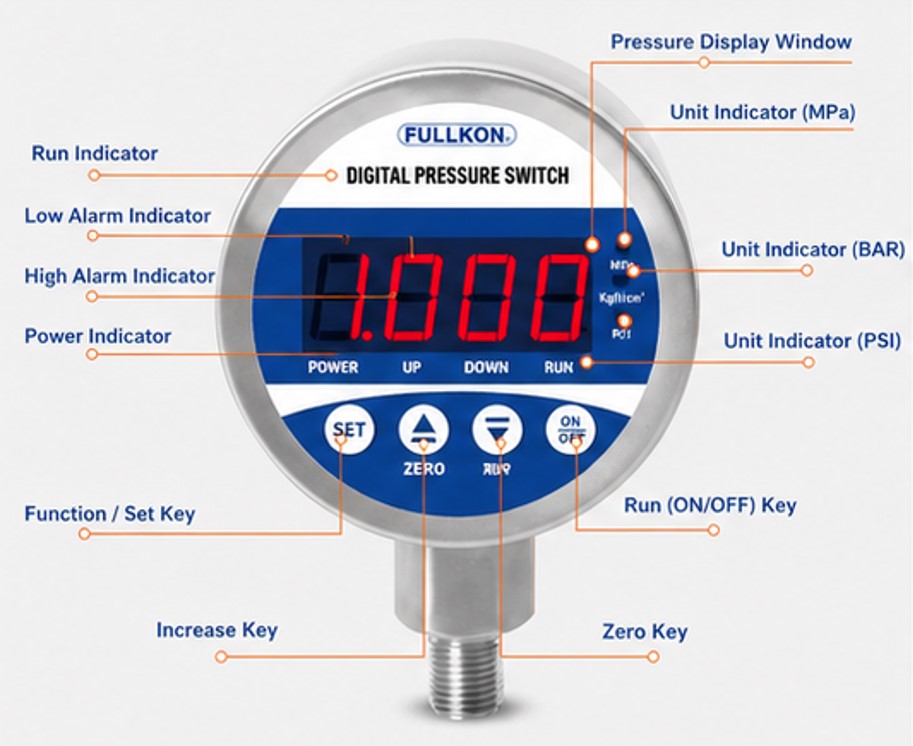
PS-100 Digital Pressure Switch

Product Specifications

Product TypePressure Switch / Pressure Sensor Switch
ApplicationWater pipe pressure monitoring and pump control
MediumWater or compatible liquid
Pressure RangePlease check with us for available pressure range
OutputElectrical switching contact
InstallationPipe, pump, or pressure line installation
UsagePressure control, pump automation, safety monitoring

Product NameDigital Pressure Switch
ModelPS-100
Pressure Range-0.1 to 60 MPa
Power Supply24VDC, 220VAC, 380VAC optional
Alarm OutputDual relay signal, each group normally open / normally closed
Alarm SettingFull range adjustable
Control OutputDual relay output
Load Capacity24VDC 3A, 220VAC 3A
Process ConnectionM20 × 1.5, G1/2, G1/4
Operating Temperature-20°C to 60°C
Measuring MediumGas, oil, water, and other media compatible with 304 stainless steel
Wetted Material304 stainless steel pressure port
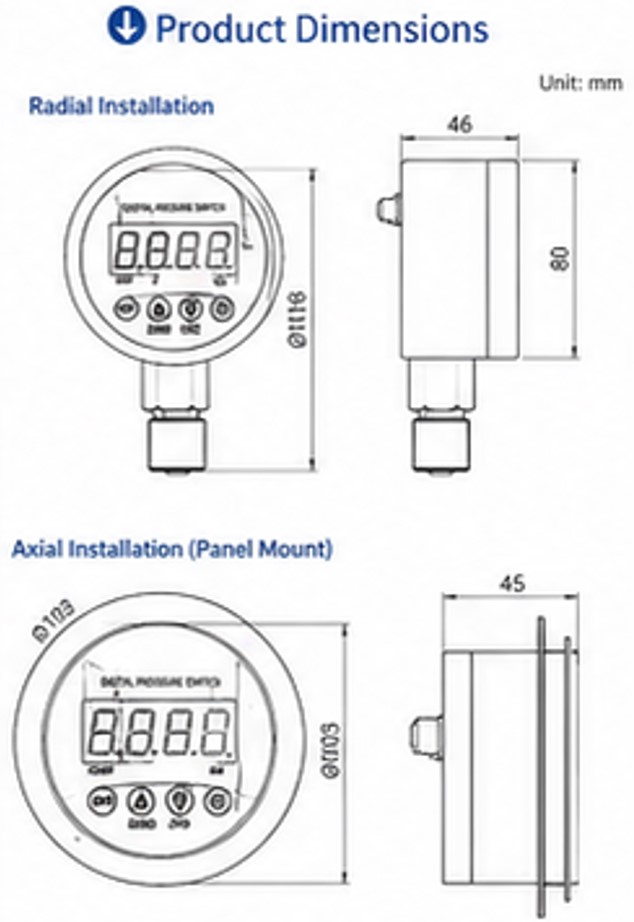
InstallationAxial or radial installation optional
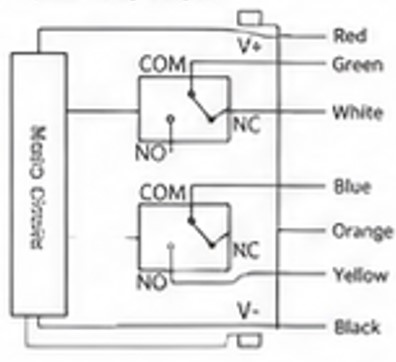
Wiring DefinitionPower: red / blue. High alarm: green. Low alarm: yellow. Common: black.

Model PS-100

Product NameDigital Pressure Switch with Plastic Housing
ModelPS-100
Pressure Range-0.1, 0.1, 0.6, 1, 1.6, 2.5, 6, 10, 25, 40, 60 MPa options
Overload Pressure150%
AccuracyBetter than 1%
Power Supply12VDC, 24VDC, 220VAC, 380VAC optional
Alarm SettingFull range adjustable
Output SignalRelay switch output
Load Capacity380V 3A, 220V 5A, 24V 5A
Sampling Rate5 times per second
Operating Temperature-20°C to 80°C
Measuring MediumGas, oil, water, and other media compatible with 304 stainless steel
Wiring ProtectionReverse polarity and short circuit protection
Process ConnectionM20 × 1.5, G1/2, G1/4
Wiring DefinitionPower: red / blue. Output: black / white.

Suitable for Singapore Water Pressure Applications

This pressure switch is suitable for customers in Singapore who need to monitor or control pressure in water piping systems. It can be used by contractors, maintenance teams, equipment builders, facility managers, and industrial users.

Whether you are replacing an existing pressure switch or building a new water pressure control system, we can help you select a suitable model based on your pressure range, connection size, and control requirement.

Product Dimension

Wiring Connection

Before Ordering

To recommend the correct pressure switch, please provide the following information:

  • Required pressure range
  • Pipe connection size
  • Type of liquid or medium
  • Electrical contact requirement
  • Application: pump control, alarm, monitoring, or safety
  • Quantity required

Need Help Choosing the Right Pressure Switch?

If you are unsure which pressure switch is suitable for your water pipe system, contact us with your application details. We can help you check the pressure range and recommend a suitable option.

Contact us today for pressure switch availability, pricing, and technical support in Singapore.

ICSP Circuit Design for Microchip microcontrollers

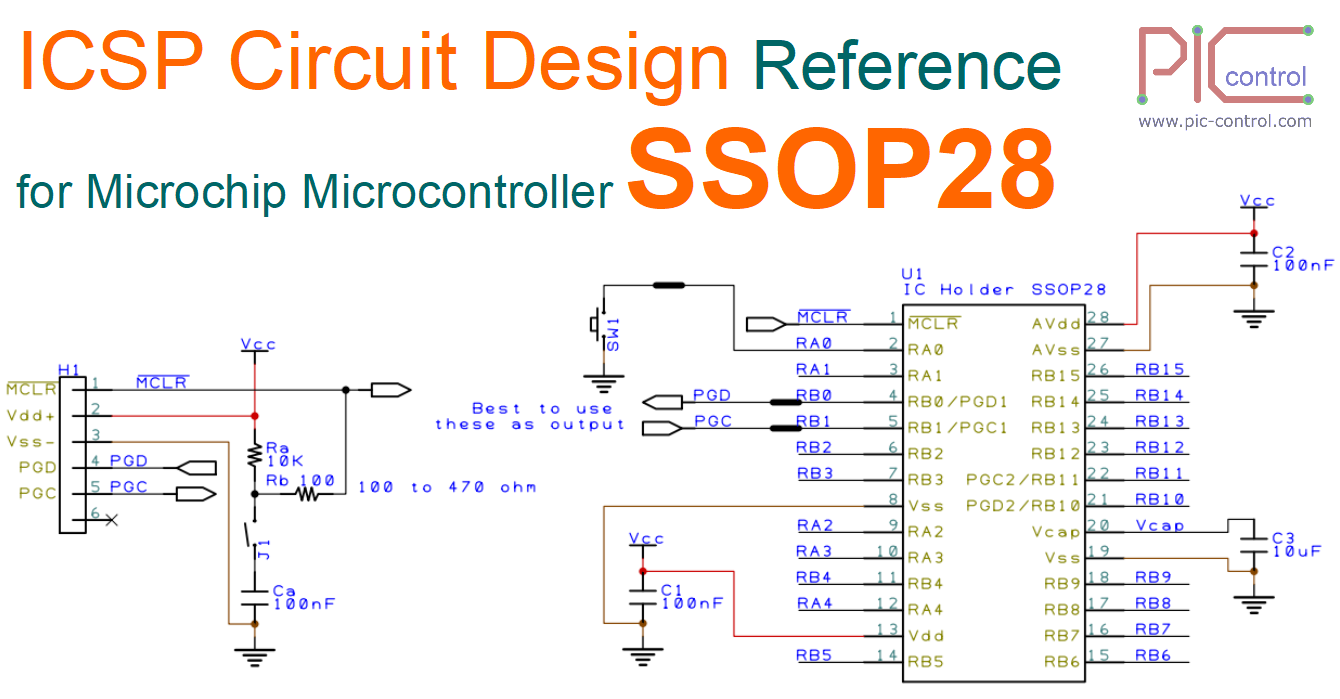
This page provides standard ICSP circuit design references for Microchip microcontrollers in SSOP-28, TSSOP-14/20, and SOT23-6 packages. These schematic blocks are intended for direct reuse in new designs, helping engineers implement a proven programming interface quickly and consistently.

Introduction

In-System Programming and Debugging (ICSP) is the standard method used to program many Microchip microcontrollers directly on the target board. Because the ICSP connection is widely used across products and projects, engineers often look for a proven reference circuit that can be copied into a new design with minimal modification.

This page provides standard ICSP circuit design references for common Microchip microcontroller package options. The goal is to give hardware designers a quick and reliable starting point for schematic capture and PCB design, while helping maintain programming compatibility, debugging access, and good signal integrity.

The reference circuits shown here cover three common package groups from Microchip microcontroller:

  • SSOP-28
  • TSSOP-20 / TSSOP-14
  • SOT23-6

These circuits are intended as standard implementation examples for typical engineering use. In most cases, they can be copied directly into a design and then adjusted only as needed for product-specific power, reset, connector, or layout requirements.

Standard ICSP Circuit Design Reference

This section collects standard ICSP schematic references for commonly used Microchip microcontroller packages. These designs are intended to support fast development and consistent implementation across projects.

Each reference circuit includes the essential connections required for device programming and, where applicable, debugging:

  • VPP / MCLR
  • VDD
  • VSS
  • PGD (Program Data)
  • PGC (Program Clock)

Depending on the device family, additional considerations such as pull-up resistors, decoupling capacitors, isolation resistors, or shared application pin usage may also apply.


Design Objective

The purpose of these reference circuits is to:

  • provide a known-good ICSP implementation
  • reduce schematic design time
  • improve consistency across hardware platforms
  • minimize programming and debugging issues during development and production
  • give engineers a circuit they can confidently reuse in new designs

These references are especially useful when the ICSP pins are multiplexed with application I/O and the designer needs a practical, standard connection approach.


General ICSP Design Guidelines

When using these reference circuits, the following practices are recommended:

1. Keep the ICSP interface accessible

Always provide a clear connection path to the programming tool through a dedicated header, test pads, pogo-pin interface, or production fixture.

2. Protect MCLR / VPP behavior

The MCLR/VPP line must support both normal device reset behavior and programming voltage entry requirements. Use the recommended pull-up network and avoid excessive loading on this pin.

3. Manage shared PGC and PGD signals

If PGC and PGD are also used by the application circuit, ensure connected circuitry does not interfere with programming or debugging. Isolation resistors may be used where needed.

4. Place decoupling capacitors close to the device

Power stability is important during programming and normal operation. Place bypass capacitors close to the microcontroller power pins.

5. Keep routing short and clean

Route ICSP signals with short, direct traces where possible. Avoid unnecessary stubs, heavy capacitive loading, or strong pull devices that can affect signal quality.

6. Verify connector orientation and pin definition

Use a consistent ICSP pinout and clearly mark the connector orientation in the schematic and PCB silkscreen to prevent programming errors.


Reference Circuits

1. SSOP-28 Microchip Microcontroller

This reference shows the standard ICSP implementation for Microchip microcontrollers in SSOP-28 package format. It is suitable for designs where the device provides a larger I/O count while still requiring a straightforward programming interface.

ICSP for SSOP28 Microchip Micro-controller

Typical use cases include:

  • general embedded control
  • mixed I/O applications
  • cost-sensitive designs using 8-bit Microchip MCUs

The reference circuit includes the required ICSP connections and recommended support components for stable programming and debugging. It can be used as a baseline schematic block in new SSOP-28 designs.

Recommended notes for this section:

  • show ICSP header or programming pads
  • identify MCLR/VPP pull-up arrangement
  • show VDD and VSS connection points
  • identify PGC and PGD pins by device pin number
  • note any resistors used for signal isolation if pins are shared with other functions

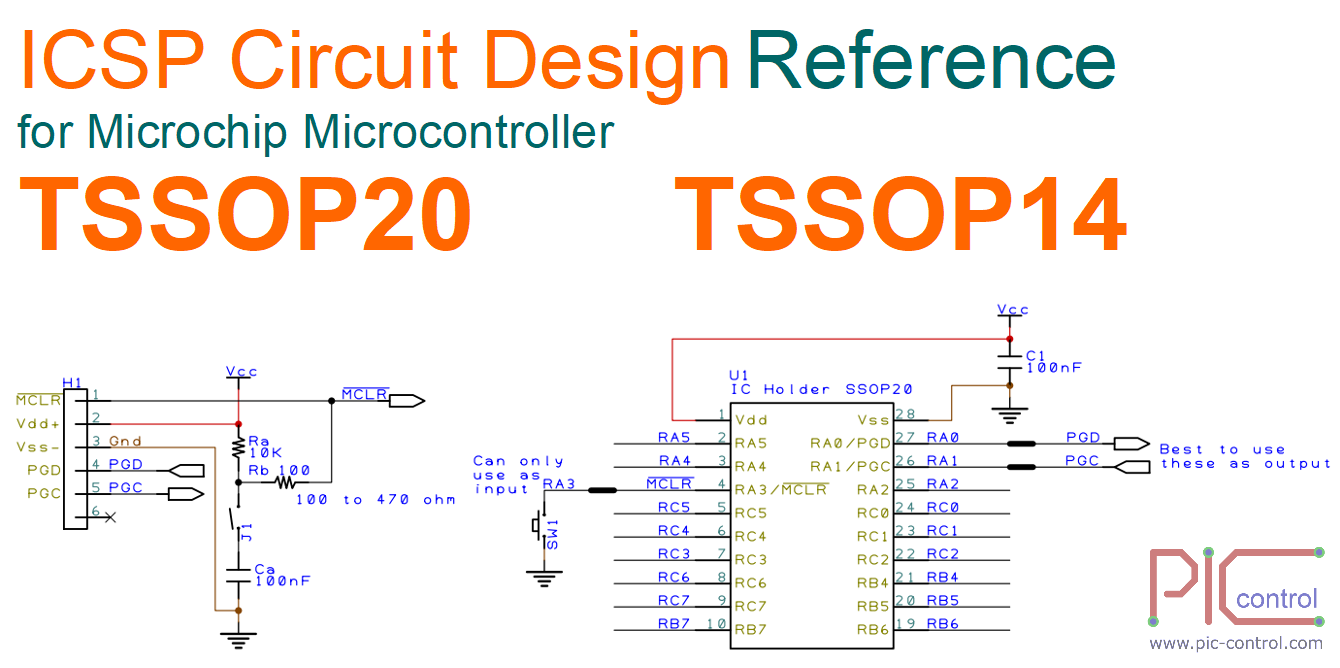
2. TSSOP-14 / TSSOP-20 Microchip Microcontroller

This reference covers TSSOP-14 and TSSOP-20 package devices. These packages are commonly selected for compact designs that still require a standard external ICSP interface.

Because pin count is lower, programming pins are often shared with functional application signals. For that reason, attention should be given to loading, signal direction, and any external circuitry attached to MCLR, PGC, and PGD.

ICSP for TSSOP20 TSSOP14 Microchip Micro-controller

This reference is intended to provide a compact, reusable ICSP design block that fits well into space-constrained products while preserving programming reliability.

Recommended notes for this section:

  • indicate which version applies to 14-pin and 20-pin devices
  • call out any common circuit differences if they exist
  • note precautions for multiplexed I/O on PGC/PGD
  • show recommended decoupling and reset components
  • indicate connector or pad access for manufacturing and development

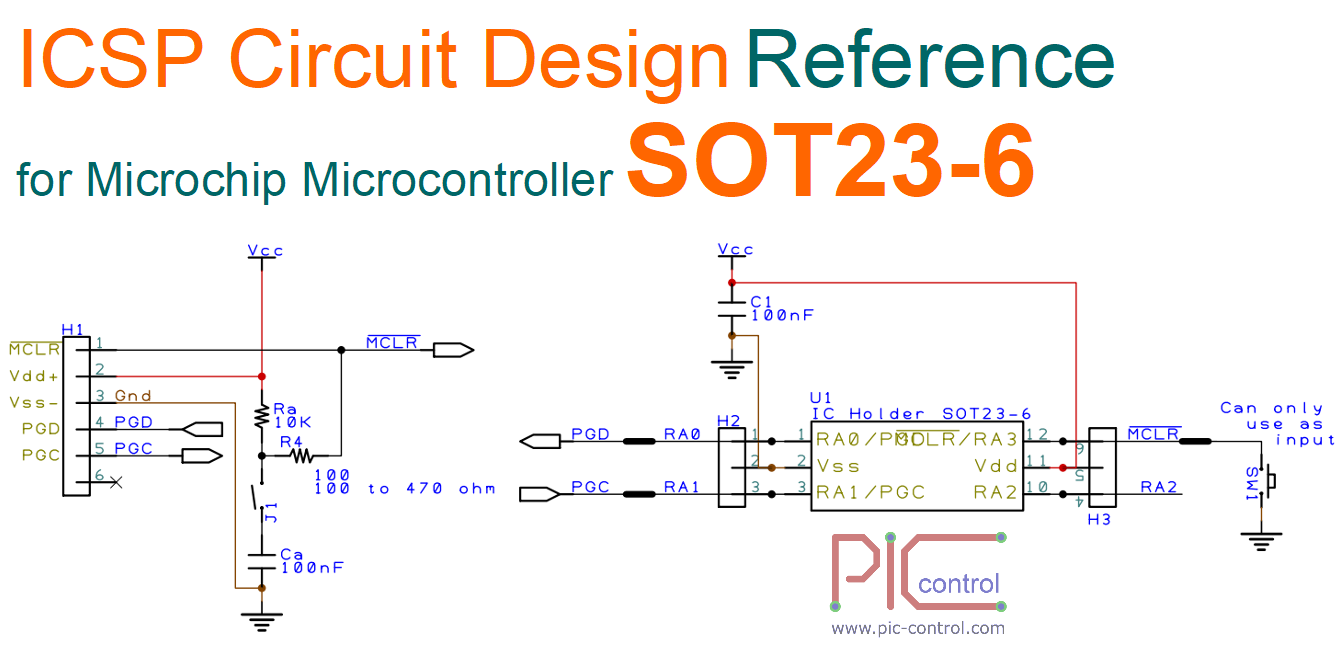
3. SOT23-6 Microchip Microcontroller

This reference provides the standard ICSP circuit for SOT23-6 Microchip microcontrollers. These devices are typically used in highly space-constrained applications where simplicity, small size, and low component count are important.

Because of the very limited number of pins, nearly every signal is critical. The ICSP design must therefore be implemented carefully so that programming access is preserved without disturbing normal application behavior.

ICSP for SOT23-6 Microchip Micro-controller

This reference is intended as a compact standard solution for small-form-factor products and should be used as the preferred starting point for SOT23-6-based designs.

Recommended notes for this section:

  • identify the programming pins clearly
  • highlight any pin-sharing constraints
  • keep support circuitry minimal but compliant with programming needs
  • note layout sensitivity due to package size
  • show practical programming access method, such as test pads or fixture pads

How to Use These References

These ICSP reference circuits are intended to be copied directly into new designs as standard schematic building blocks. Before release, the designer should still confirm the following against the selected microcontroller datasheet:

  • programming pin assignment
  • MCLR/VPP requirements
  • supported debug interface behavior
  • supply voltage requirements during programming
  • any package-specific limitations
  • any family-specific recommendations from Microchip

Using a standard reference reduces risk, but final validation should always be completed for the exact device being used.


Recommended Engineering Note

These circuits are provided as standard internal design references for Microchip microcontroller ICSP implementation. They are intended to accelerate design reuse and improve consistency across projects. Final design verification remains the responsibility of the hardware engineer for the specific device and application.


Hotel Card Holder Switch

Integration-Ready Card Switch

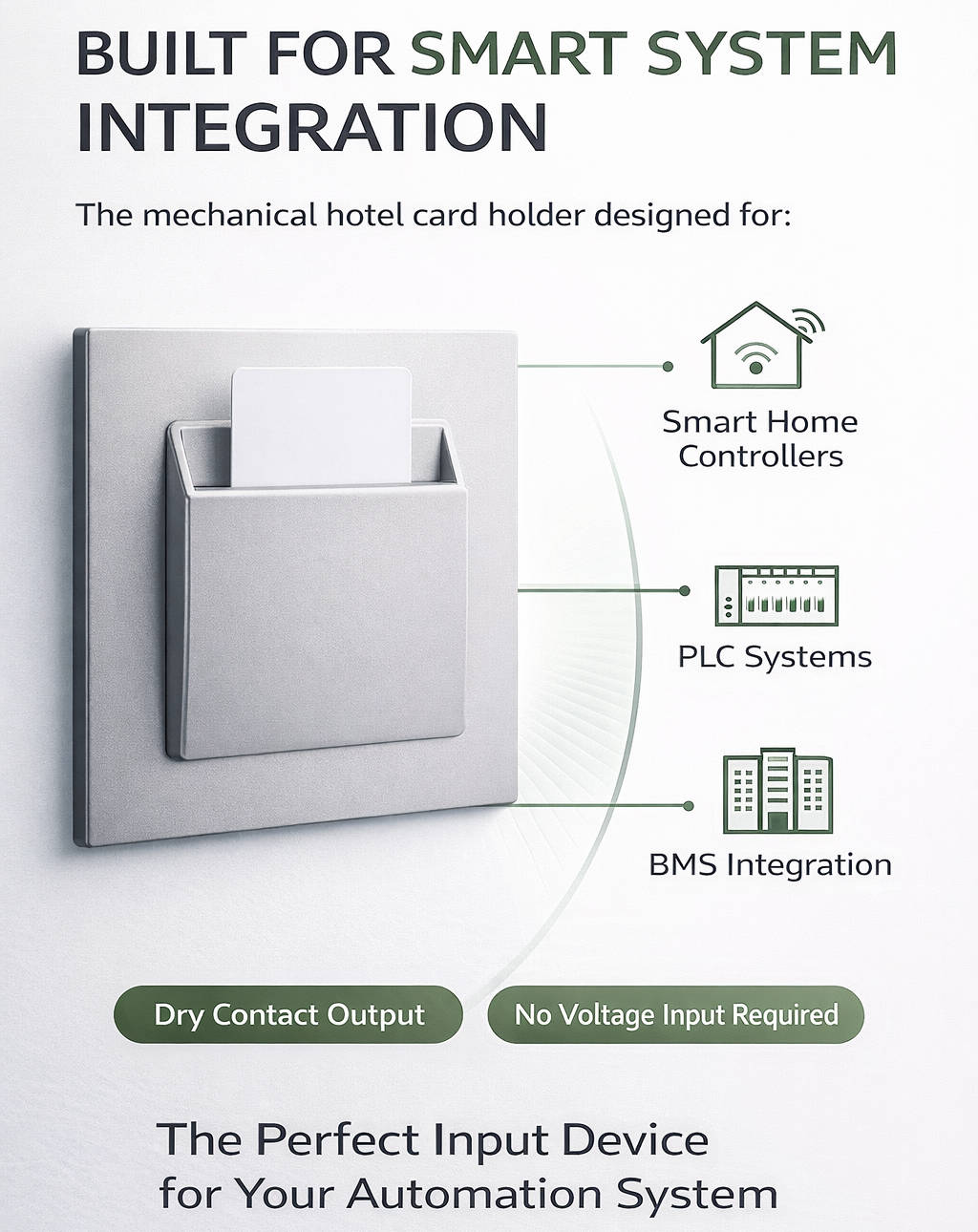
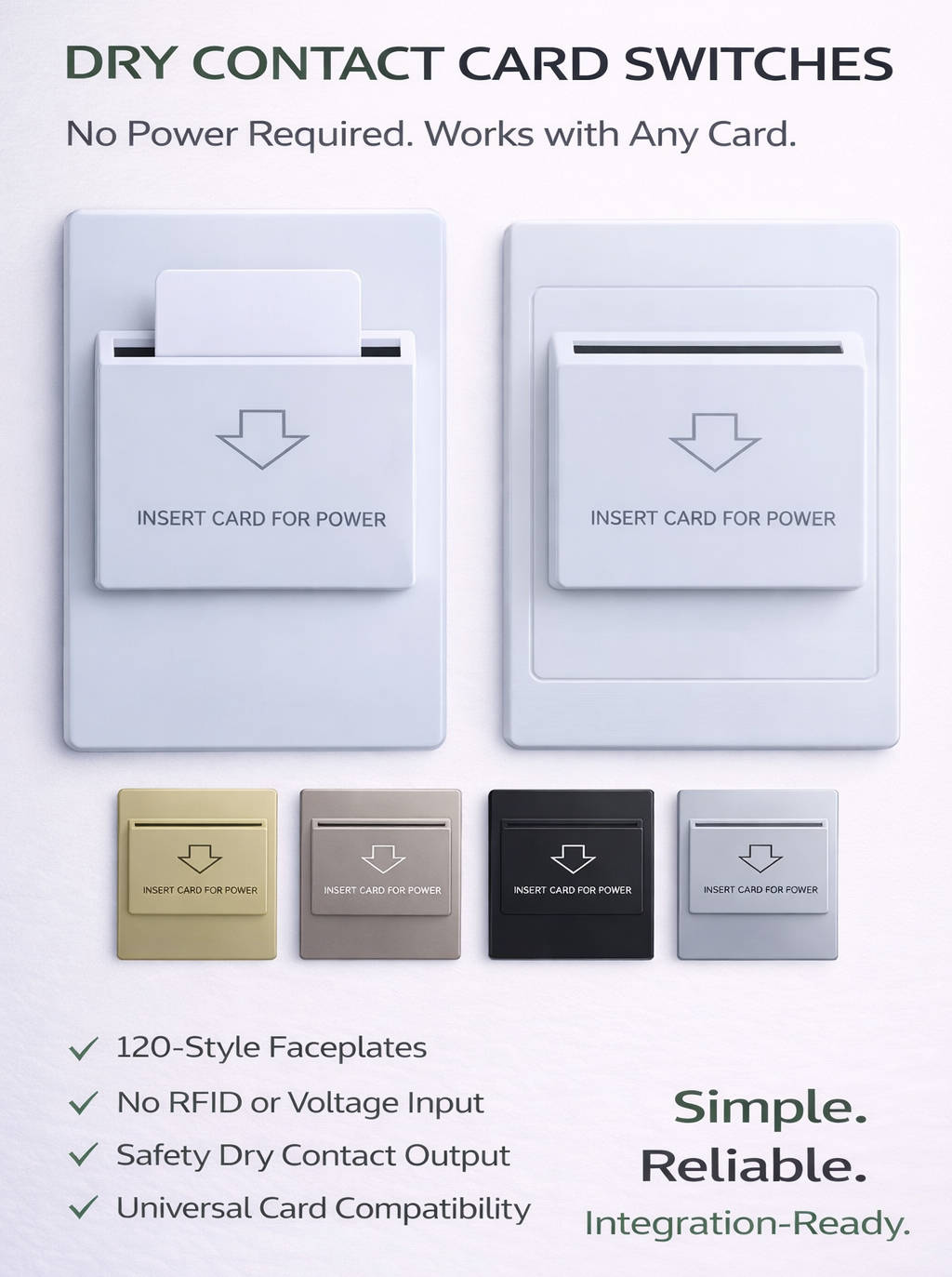
Hotel Card Holder Switch for automation system integration

Simplify Access. Maximize Control.

In today’s smart environments, complexity is often the biggest obstacle. Traditional hotel card switch holders rely on RFID technologies, voltage requirements, and proprietary systems — making integration difficult for modern smart homes and PLC-based automation.

Introducing the Mechanical Hotel Card Holder Switch — a simple, reliable, and integration-friendly passive card holder switch designed specifically for smart system professionals.

Designed for Smart Integration

Unlike RFID-based card holders, this solution uses a pure mechanical switch mechanism. No frequency compatibility issues. No signal interference. No unnecessary electronics.

Just insert a card — and the system responds instantly.

This makes it ideal for:

  • Smart home integrators
  • KNX/EIB smart home automation system
  • PLC automation systems
  • Building management systems (BMS)
  • Custom IoT solutions

Features

  • No Power Required
  • Dry Contact Card Holder Switch
  • Suitable for Low Voltage System
  • Integration-Ready Card Switch

Key Features:

Universal Card Compatibility

Works with any card size — hotel cards, membership cards, or even custom placeholders. No RFID dependency.

Dry Contact Output

Provides clean, voltage-free switching (dry contact), making it easy to connect to:

  • Smart home controllers
  • PLC inputs
  • Relay modules
  • Low-voltage automation systems

No Power Required

Unlike traditional 230VAC units, this device:

  • Requires no external power supply
  • Eliminates wiring complexity
  • Reduces installation cost

Instant Response

Pure mechanical action ensures:

  • Zero latency
  • High reliability
  • Long operational life

Clean & Minimal Design

Modern, neutral aesthetics that fit:

  • Hotels
  • Serviced apartments
  • Smart homes
  • Offices

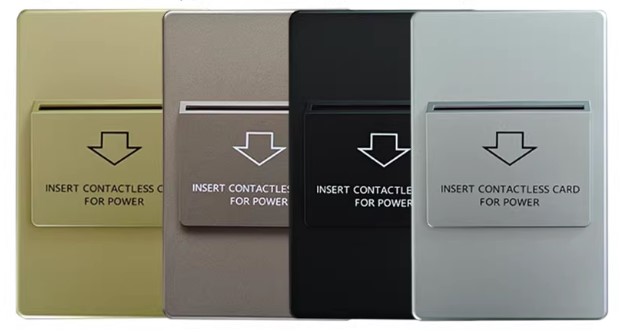
4 Colours to Choose from

  • Classic White
  • Matte Black
  • Champagne Gold
  • Silver Grey
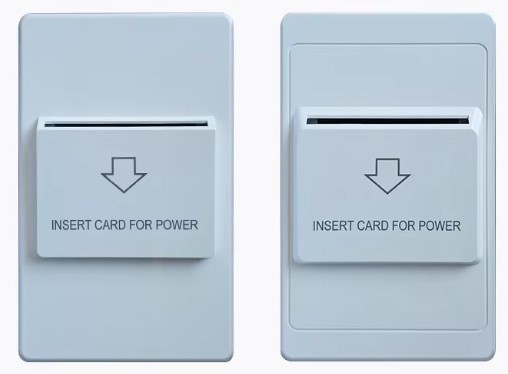
4 colours to choose from (mechanical card holder switch 86 x 86mm faceplate)

Dimension of Card Holder

Standard 86x86mm socket

Also available in 120 type style faceplate

Style: 120 type faceplate

Custom Logo & Text

Faceplate customisation is available. Please contact us with your designed layout.

Perfect for Smart Systems

This product is built with system integrators in mind.

Seamless Integration Examples:

  • Trigger lighting scenes via smart controller
  • Enable HVAC systems when card is inserted
  • Activate energy-saving modes when removed
  • Interface directly with PLC digital inputs

🏗️ Ideal Applications

  • Smart homes
  • Boutique hotels
  • Airbnb / serviced apartments
  • Office energy-saving systems
  • Industrial control environments

💡 A Smarter, Simpler Choice

When your system already has intelligence, you don’t need more electronics — you need reliable input.

This mechanical card holder gives you exactly that:

  • No compatibility issues
  • No unnecessary complexity
  • Just clean, dependable switching

📦 Product Summary

  • Type: Mechanical card holder switch
  • Output: Dry contact (NO/NC options available)
  • Power: Not required
  • Compatibility: Universal card support
  • Installation: Standard wall box

🚀 Ready to Integrate?

Upgrade your projects with a solution designed for simplicity, flexibility, and reliability.

Contact us today to request a quote.

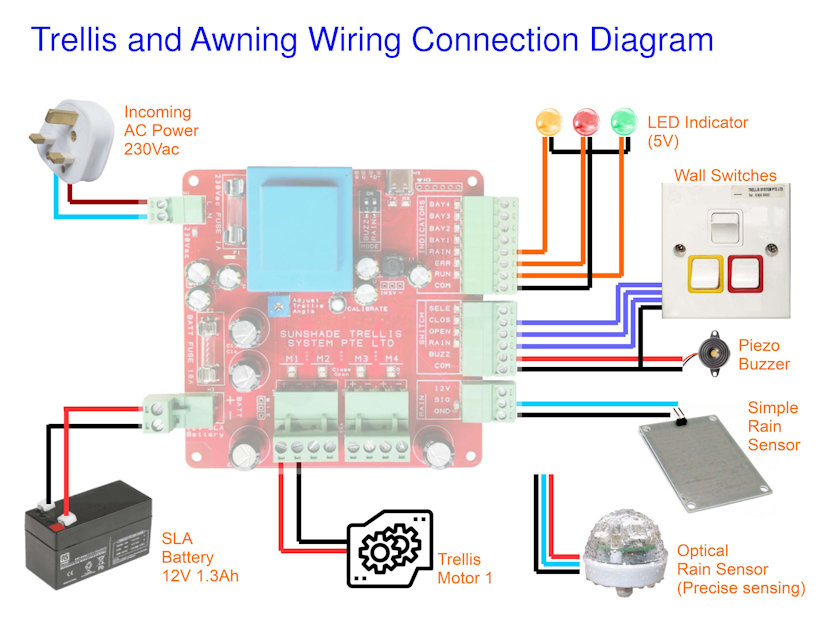
Automated Trellis Shade Control System

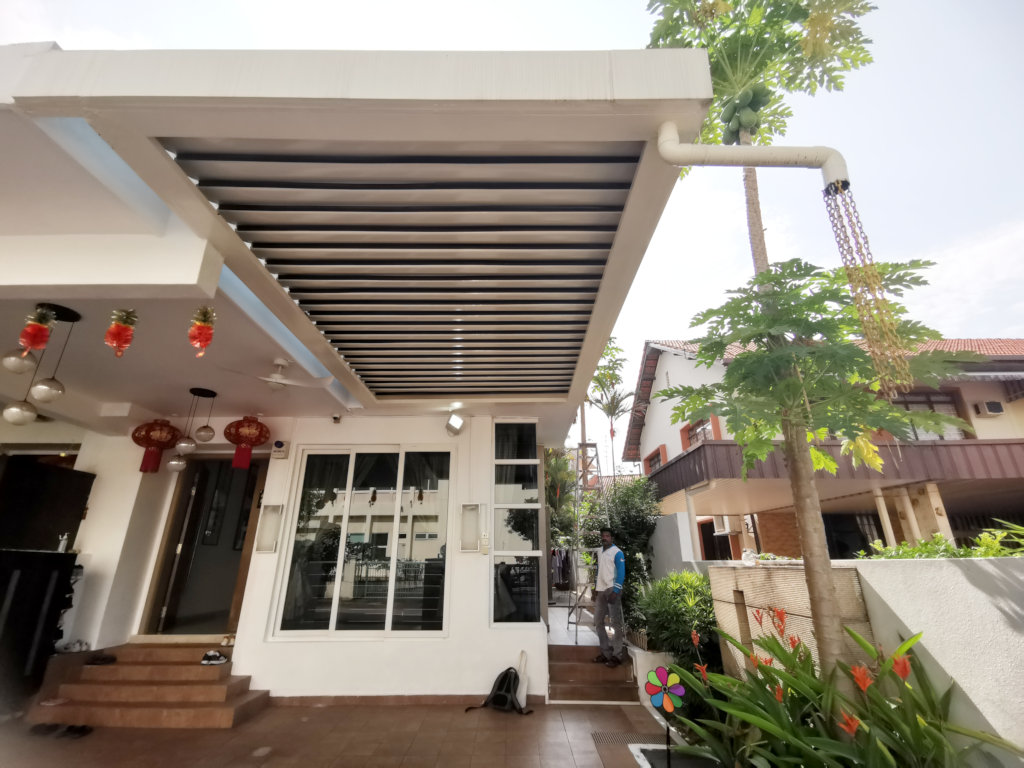
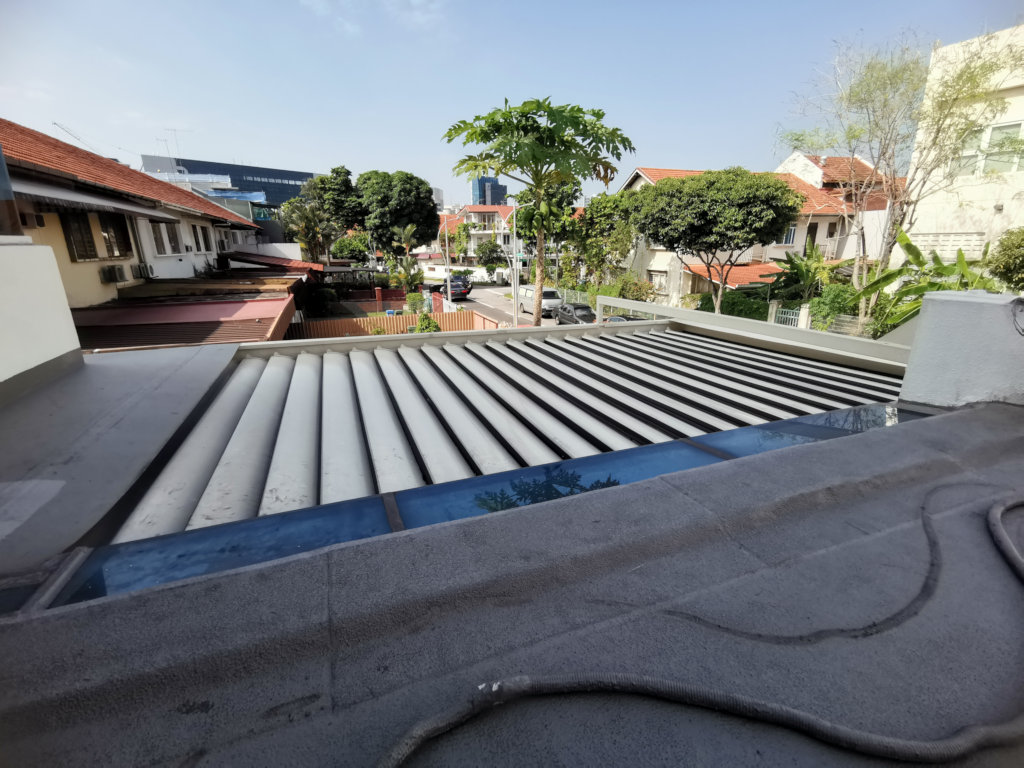
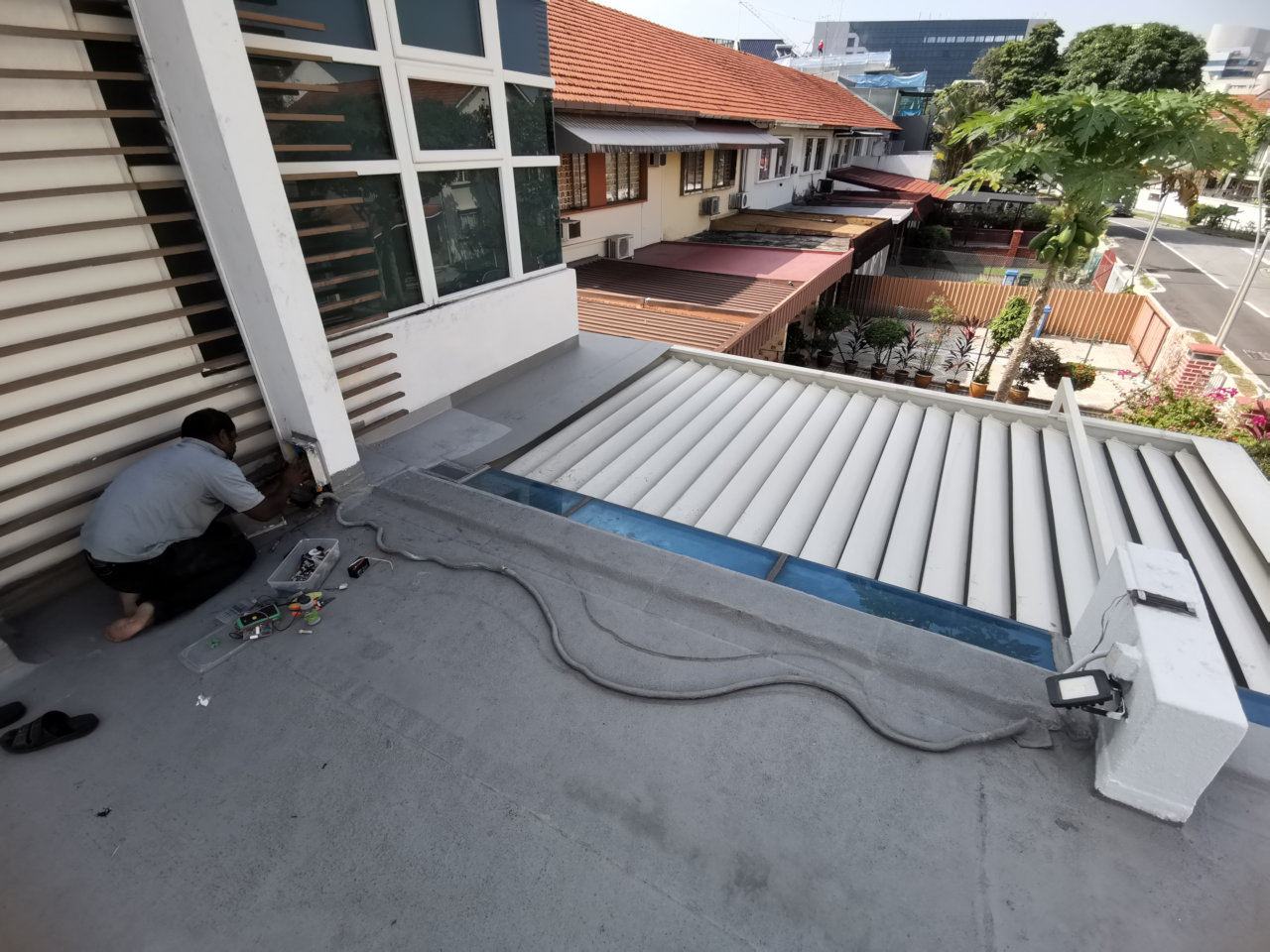
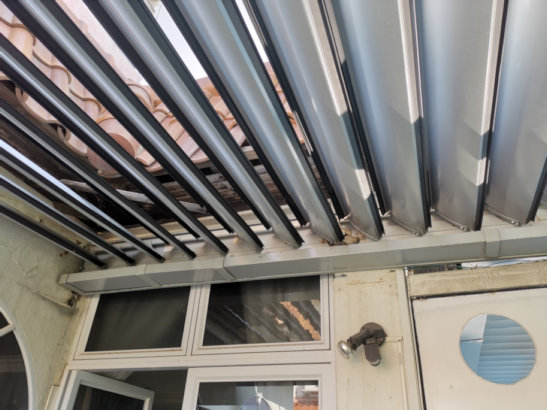
An Automated Trellis Shade Control System is becoming increasingly popular in Singapore due to the city’s hot climate, strong sunlight, and frequent sudden rain. These systems feature a smart roof structure—typically built with aluminium louvers or retractable fabric—that can open or close automatically depending on weather conditions.

Product Information

Product of Sunshade Trellis System Pte. Ltd. (Singapore)
Visit website: https://sunshadetrellis.wixsite.com/home

How the System Works

The trellis is powered by a motorised mechanism that allows the louvres or fabric panels to turn open for ventilation or sunlight and close completely for protection. When the system is in the sun shade position, it reduces heat gain on balconies, patios, and rooftop terraces.

Because the system is automated, it can operate on its own without user input. Sensors monitor environmental conditions, and the trellis will auto-close when rain is detected. This is especially useful in Singapore, where showers often come unexpectedly. At the same time, the roof can open automatically when conditions are safe, allowing airflow and natural daylight.

Trellis is an alternative to an awning for those who prefer a solid structure that can withstand wind and rain.

Key Features

  • Automated open/close control through remote, wall switch, or mobile app
  • Weather sensors that trigger auto-close when it rains
  • Adjustable louvre angles that let users turn open the roof partially or fully
  • Effective sun shade during peak afternoon heat
  • Strong, durable structure suitable for tropical climates

Why It’s Ideal for Singapore

Outdoor living spaces in Singapore—from HDB balconies to landed patios—benefit greatly from flexible weather control. An automated trellis enhances comfort by blocking heat, keeping areas dry, and providing a reliable shade solution that adapts instantly to changing skies.

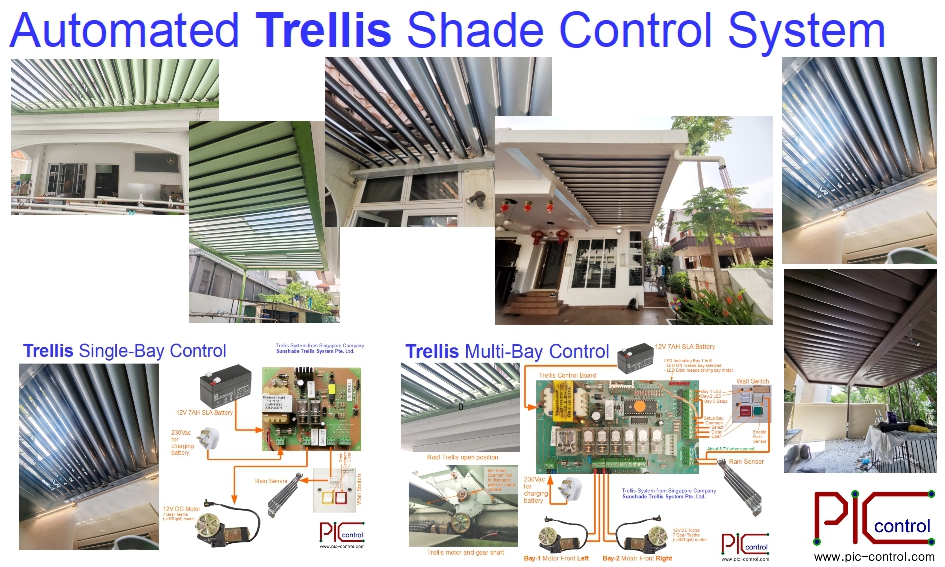
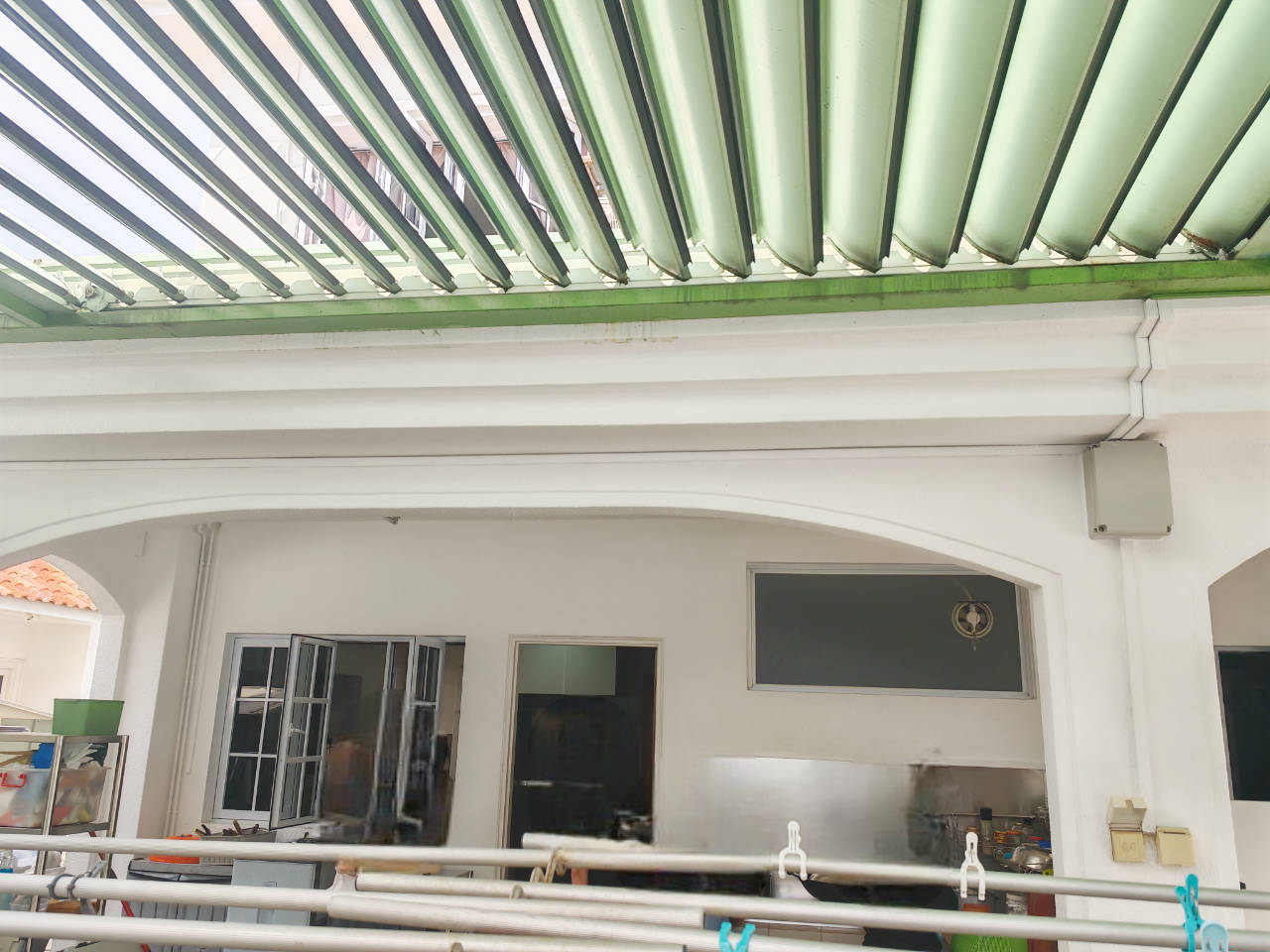
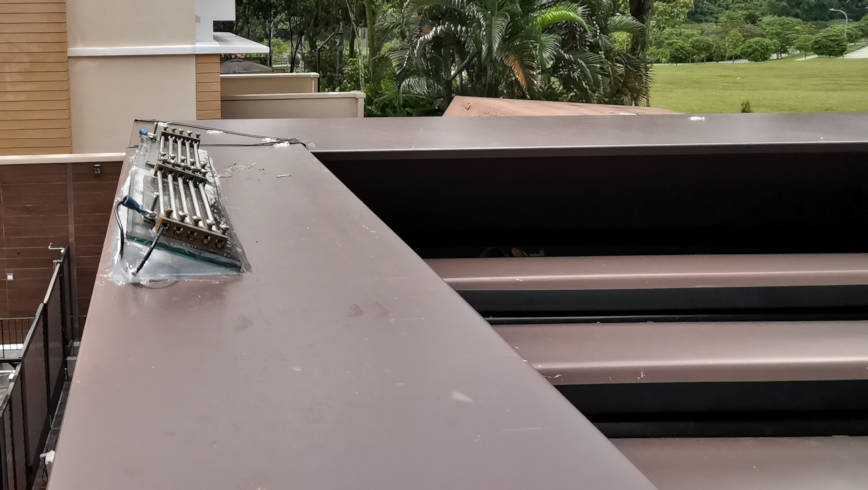
Project 1

by Sunshade Trellis System Pte. Ltd. (Singapore)

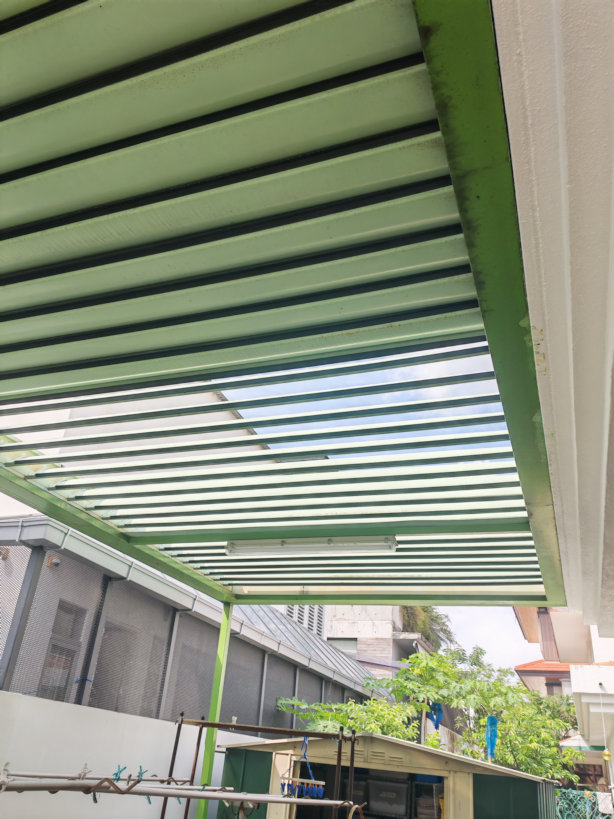
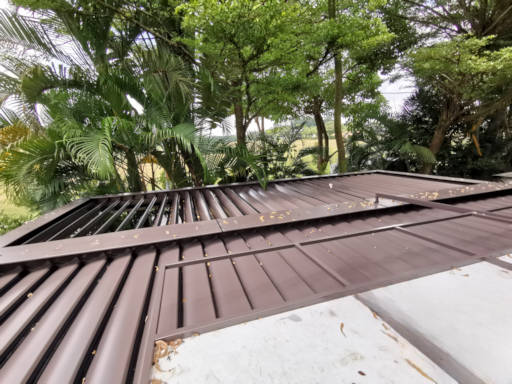
Project 2

by Sunshade Trellis System Pte. Ltd. (Singapore)

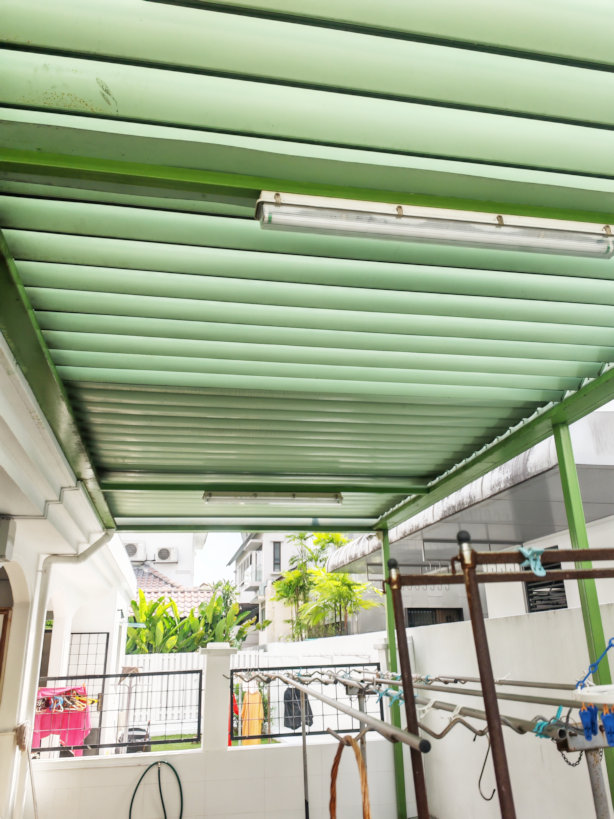
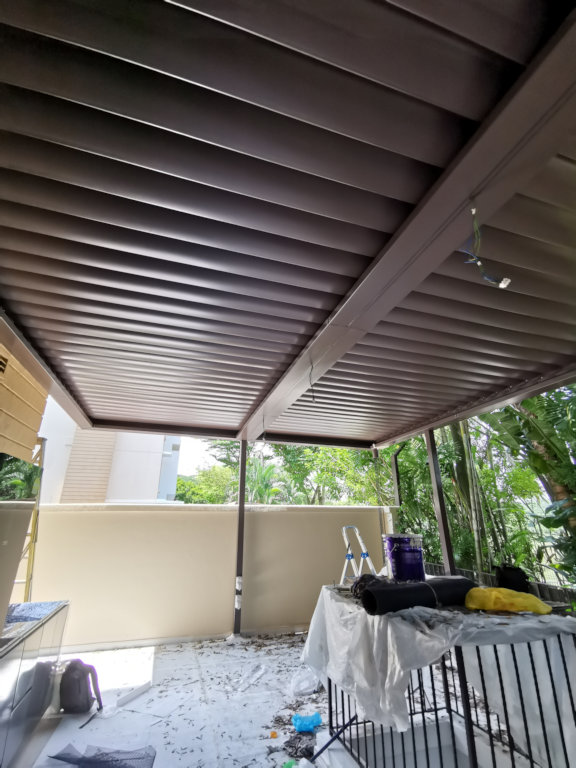
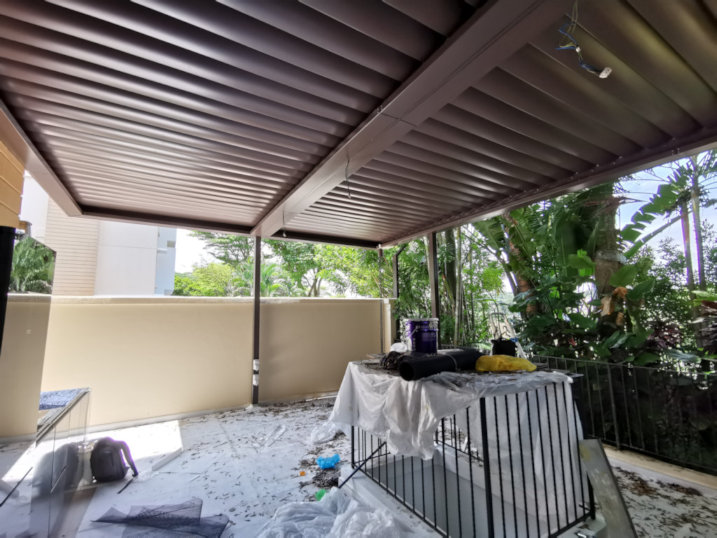
Project 3

by Sunshade Trellis System Pte. Ltd. (Singapore)

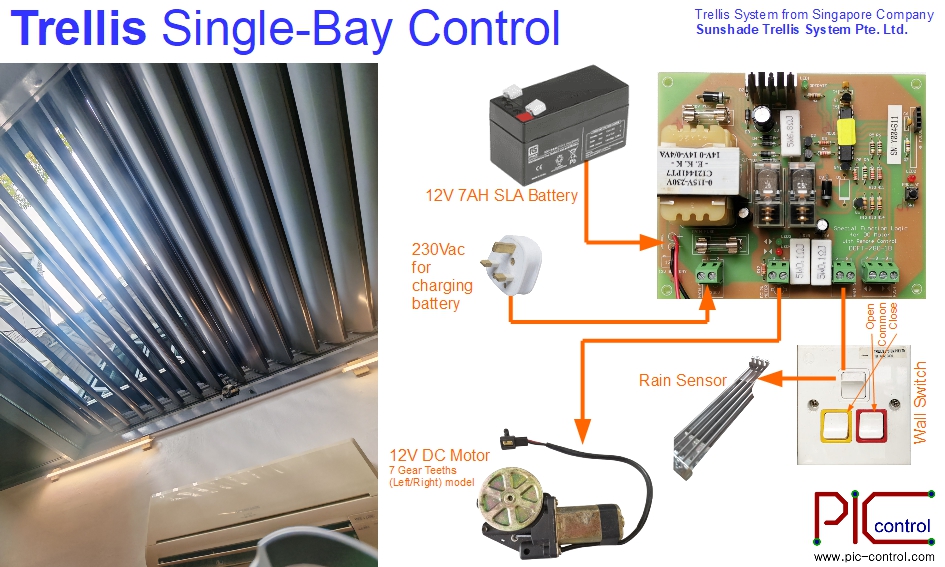
Trellis Single-Bay Control Board

Single-Bay Trellis control board from
Sunshade Trellis System Pte. Ltd. (Singapore)

This control board provides the control for a single bay roof Trellis system. It can be identified from the 3 switches user control wall-switch.

Trellis Single-Bay Control Board Wiring Schematic

The top button is a rain sensor enable switch. Switching it to the down position will enable rain sensing. The Trellis will automatically close the Trellis from it detects the rain.

The two lower buttons are for Trellis panel control.

The left (yellow) momentary switch is for opening the Trellis roof panel. A single quick press and release will activate the Trellis to open the roof panel fully. If this button is pressed (and held), the panel will turn to open and halt only when the button is released.

The right (red) momentary switch is for closing the Trellis roof panel. A single quick press and release will activate the Trellis to close the roof panel fully. Similar to the open button, when this button is pressed (and held), the panel will do the closing and halt only when the button is released.

Trellis Multi-Bay Control Board

Multi-Bay Trellis control board from
Sunshade Trellis System Pte. Ltd. (Singapore)

This multi-bay board provides the control for 2 or more roof Trellis bay systems. It can be identified from the 4 switches user control wall switch.

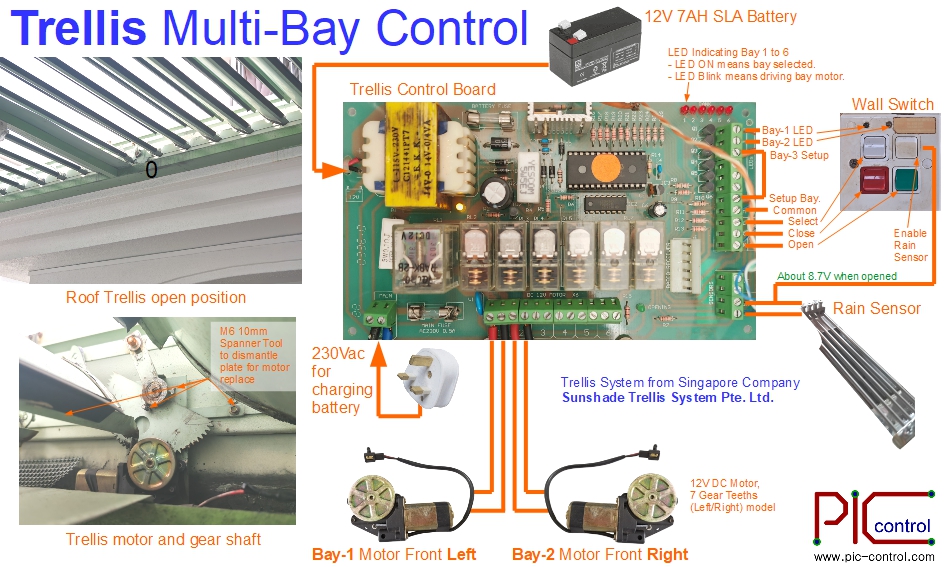
Trellis Multi-Bay Control Board Wiring Schematic

This multi-bay user interface is similar to the single-bay version. It has an extra switch on the top left corner of the user switch panel. This button selects the bay that you want to control. Press one time for bay number 1, press two times for bay number 2.

The selected bay can be seen from the LED indicator (turned on) on the switch panel. The LED, starting from the left, indicates bay number 1, 2, 3, all the way to bay 6, which is the maximum number of Trillis roof bays this board can support.

Only when a bay is selected can the open/close button function. A blinking LED indicates that the board is now driving the motor of the particular bay when the open/close button is pressed. The LED indicator on the circuit board will also be lit up, indicating the status of the operation.

Troubleshooting the controller board.

— To be updated soon —

Battery Replacement

The system uses SLA (Sealed Lead Acid) battery as a means to drive the DC geared motor. Typical installation uses 12V 7Ah SLA battery. You can also use a smaller SLA battery rated 12V 1.3Ah.

These batteries can usually last for years, but they do wear off over time.

A typical full charge voltage measurement is expected to be between 13V to 13.8V. This is a healthly voltage level. When the voltage of the battery is measured below 12V, it is likely that the battery is worn and requires replacement.

Please handle the battery with care. Connect the correct polarity to the battery terminal. Please handle with care, and do not to short the positive (+) and the negative (-) terminal of the SLA battery, as it can catch fire instantly.

Motor Replacement

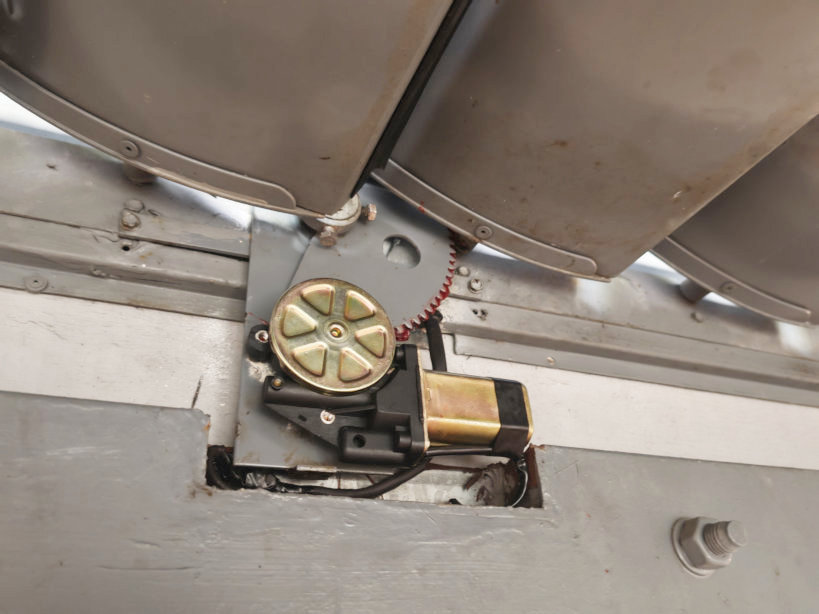
The motor used for this Trellis is a 12V geared DC motor (7 gear teeth version) that is typically used for the vehicle winding windows. It is important to note that there is a Left and Right versions of the motor.

The tools required to remove the motor panel is mainly a 10mm spanner and an Allen key set. The motor panel has to be dismounted in order for the motor to be replaced.

Trellis panel install calibration

These Trellis controllers are designed for simple installation without using any limit switch to set the motor motion boundary.

The Trellis calibrated position has its panel opened to 90 90-degree angle. At this angle, the gear teeth should be hitting the boundary limit stud. At the calibrated position, tighten the two M6 hex screw to lock the lever in position.

The panel’s closed position will naturally set the limit boundary. The panel will be closed tightly, resulting in a current surge which becomes an indicator for the controller to stop the motor.

New Model for Trellis Control Board

Click here for the newer Trellis control board model and documentation.

New automated Trellis control board

Simple Home Automation

Thinking of making your home easier to live in, making it smart and intelligent.

Affordable home automation, making living more convenient in Singapore.


Edited by Lim Siong Boon, last dated 31-Dec-2012.

Topic Discussion Overview

  1. Introduction
  2. Structured Wiring
  3. Smart Features
  4. Green and Efficient
  5. Useful Home Gadgets


Structured Wiring

Home automation is getting more and more popular nowadays. Automation simplifies our daily task in our home, making our life easy.

Home automation may seems to be a science fiction or high tech stuffs that most people will not be able to afford. In actual fact, it has already penetrate into almost all our homes.

Nearly all household in Singapore has some form of home automation. Washing clothing used to be a chore in the past. The invention of a washing machine automate the washing chores. Rice cooker, microwave and vacuum cleaner appliances which has become a part of our daily life, shortening our time to do household chores. Women in the past stay at home to do house work, while the men work outside for an income. Automation has helped to transform the women in today’s society, allowing them to walk out of their house, joining the working force. The doubling of the work force has significant contribution to an economy. These invention that automate our home frees our time and change our society in many many ways.

Home automation has comes a long way and is still finding its way into our home. Our current era is very much involved with information technology. Most of the household have internet connectivity and it has becomes one of our latest household utility besides our electricity, water, and telephone bills.

The current home automation trend focus on information connectivity of the home. The industry believes that consumer wants a digital connection to control whatever a consumer have at home. Providing the consumer with the power of control. These comes in the form of remote lighting control, motorised curtain/blind control, air-con/fan control or automated opening of door.

Green environment and energy saving is another popular trend that pushed home/office automation. The industry comes up with product integrated with sensors that will automatic switches off lights when no one is around, or maintaining a constant lighting intensity throughout the day. Energy efficient automated solution is also a popular theme.


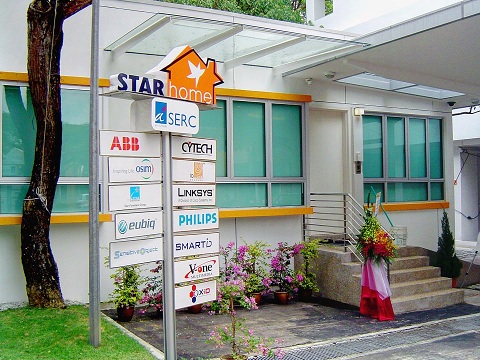
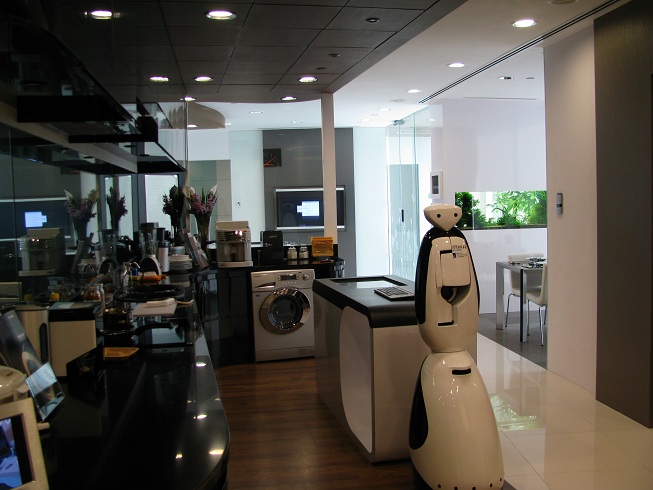
STARhome is a smart home program initiated by A-STAR. I used to work with STARhome, a smart home filled with many many latest technologies, many of which are not yet available in the market.

We had technologies like face and voice recognition which can authenticate its owner and automatically open the door for you. Automated news/sports video indexing, which segment out the clip that you are interested to watch. Voice/gesture command or mobile phone to control the lighting and appliances. Robot that listen to your command and serve you a cup of freshly brew coffee. Tracking your location in the home, streaming your favorite music where ever you go. Keeping track of your groceries inventory, so that you will never run out of your favorite food. A real time language translation device which helps translate any speech to Mandarin for my grandmother at home who is unable to understand an English speaking sales-person. A bed/chair/toilet bowl that keeps track of sleeping pattern and health condition. Video/Audio surveillance system which is able to detect elderly/children fall, or any other activities at home, notifying the home owner events that they are interested in. Self sustaining and maintainence aquarium (fish tank). A platform where smart devices communicate with one another within a home. There are many more smart little gadgets.

We have collected our experience working and living in a smart home and managed to build another one, STARhome@fusionopolis.

These technologies may seems science friction, but are already possible. They are however still not within the reached of common user like you and me. Having the opportunity to work in STARhome has provided me some insight to what a smart home means to me. A smart home that is affordable, simple and easy to use. Just like how a washing machine came into our home.


Most home automation that I have seen and worked with in the market are quite impressive and contains a lot of functions. However they do not meet the smart home definition that I have in mind. Affordable, simple and easy to use. Many smart devices that are available in the market are suppose to make our life easy, but very often, I find it is even more difficult to setup and use. Even a television set that has been evolving for decades, seems more and more complex to use. The number of buttons are growing on the remote control, the functions are getting difficult to set.

Compare to an old television, the television now has more functions, but requires more steps to get a simple task done. Very often, I will have to help my parent and elderly to setup or even use the new television. The elderly may have aged, but they can still manage simple old appliances which are easiler to use.

Innovation like a thermo flask has once overwhelm me. There is a time when I spent quite a long time trying to figure out how to get the hot water out of the flask for my cup of 3-in-1 coffee. There was so many buttons on the flask and they have really confused me, making me looking like an idot. Making an electronic engineer who is working with the latest technologies, looking like an idot. The old mechanical thermo flask has only two button at most. One big push button on the top of the flask to pump out the hot water, and another one to lock the pump (for safety in case children play with the flask and get themselves scalded).

Most of the high tech stuffs reallys piss me off, because they are not designed for wonderful user experience; it is design for the seek of looking high tech. The experience has rised my awareness for a better user experience.

I would like to delicate this page to talk about the stuffs that I would like see in a automated home. Pros and cons of the existing concept of smart home gadgets available on the market. Also important things to take note when building your dream home in Singapore. Many interior designers and contractors are still green in the area of home automation, so it is important to know what you want to look for in your home. It is you who are living in your home after all.


www.pic-control.com, Singapore Network Ethernet WiFi RS232 RS485 USB I/O Controller


Structured Wiring

Smart home automation is becoming part of our home utilities, and it is important to design the infrastructure of your home to cater for the coming technologies trend. Provision wiring to meet future demands can save you cost.

The reason for provisioning the infrastructure is to avoid re-laying the cables. It is unlikely to have any further changes to the wiring, the access to the cable trunking should still be accessible. You can hide the cables but try not to seal it. Maintenance is necessary at times.

Structured wiring or cabling is a set of standard to lay the cable infrastructure, to ensure that interference is minimum. There are a few types of cable services that we can have in our home.

– AC Power 110-230Vac
– Digital data (Network, broadband)
– Analog signal (TV RF antenna, telephone line, Audio/Video)

The digital data and analog signal cable should be laid a distance of about 60mm away from the AC power line. This is to prevent noise from the AC power to be coupled over to the cables carrying digital and analog signal, especially when they run in parallel. It is also good to have the signal cables shielded to minimise the interference.

Sometimes when you switch on and off our electrical appliances or lights, you may notice that your television or radio can get disturb. For new television set, your may notice that the picture gets halt for a split seconds. The spark generated from the switch get coupled into the line. There will be no spark when the AC is at its zero crossing when it switched, but the probability is low being about to switch near the zero crossing period. A soft switch or electronic switch can minimised such spark, generating less noise.

When the AC power line and signal cables has to laid parallel to each other, it is good to keep them at least a distance of 60mm apart. Cables section that are not in parallel have less interference effect compare to those in parallel.

http://www.ehow.com/how_7934045_install-structural-wiring.html


Label of the cables is a good practice which minimise any inconvenient in future. Contractors do not bother to label the cables, because they are able to remember and managed them. As more and more cables are laid over the years, it can get more and more messy. Future contractor will have a hard time tracing the cables. It is always good to label the cables especially for structured wiring because there will be more variety of wiring which are more complex than before.

In Singapore, structured wiring can often be found in office and factory buildings, but is not adopted for home use. It is still a relatively new things for the home industry.

The typical wiring infrastructure that are adopted in our Singapore home are mainly:
– 230Vac cables (40-60A for HDB flats)
– TV RF/antenna cable
– Telephone cable

Fiber optic cable is available but not a popular choice. This is maybe due to the cost compare to other options.
In older homes, TV and telephone cable services are laid only to the living room;only the power cable is available at each room. Today with cheaper electronics products, consumers have the luxury to have more than one appliances in the same house. Each home is expected to have more than one telephone and television. It is now a common trend to see the TV and telephone cable laid to every room.

As technology evolve, the trend is starting to change. According to the statistic of Singapore 2012, there is a declining trend of household subscribing to the telephone line. This may be due to the popularity of personal mobile phone; at about 1.5 mobile phone per person. There are also new digital phone services which uses broadband to deliver voice call instead of analog phone line; the service is cheaper compare to the telephone line.


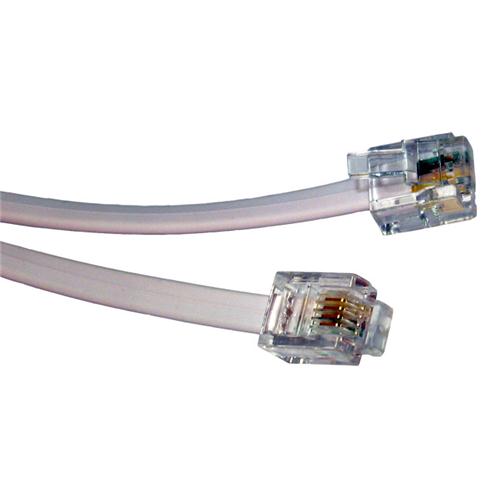
RJ11 (6pins) socket for telephone line (old type)


RJ11 (6pins) socket for telephone line (UK wall panel)


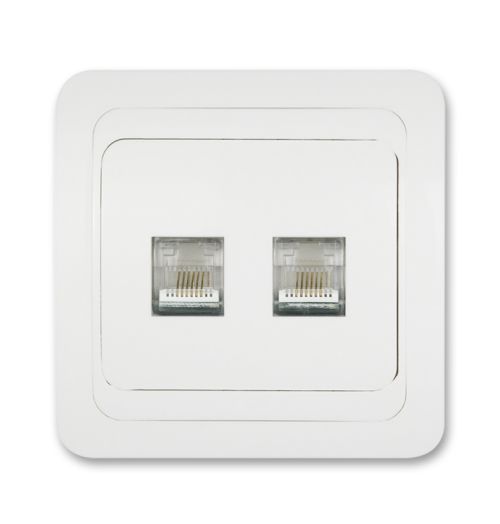
Recommended UK wall panel RJ45 (8pins) socket which is suitable for network (RJ45 jack) and telephone line (RJ11 jack) use, RJ45 jack

Telephone line is is declining. Every individual has at least a mobile phone. Telephone line (land line) that already installed are declining slowly. Most young family prefer not to install a new telephone line, as they are contactable through their mobile phone number.

Statistics on Telecom Services for 2012 (Jul – Dec)

See page ‘v’ of Report on the Household Expenditure Survey 2007/08


Telephone line may seem to be outdated, but I will still recommend the installation of infrastructure to support it. The recommendation is to install network cables instead of telephone cables. Network cable is able to host a number services like Ethernet, telephony, audio and video. This makes it a very flexible infrastructure to have.

Telephone lines do still have its unique advantages, compare to other new alternatives. Telephone line is linked directly from the phone exchange centre. The analog telephone do not requires additional power in order to work because the power comes from the telephone exchange centre. This means that in times of electricity failure, your analog phone will still works. Using a IP phones requires broadband internet and needs to be powered up from your wall power socket outlet. Using a mobile phone requires battery power. The number of mobile connection is also limited with a wireless cellular network. Power or internet connection failure will means that you will not be able to make call..

Not every household will want to install telephone line, but most will need network access in this information technology era. A recommended advise will be to laid network cables instead of the telephone lines. Network cables have 4 wire pairs which can be used for network as well as telephone purpose. Whether or not you will be using a telephone line, it is good to lay network line.

The network cables can support both the network and telephone services. RJ45 (8pins) socket is used for network cables, while RJ11 (6pins) socket is used for telephone lines. It is recommend to use a RJ45 socket, which RJ11 jack can also plug in.

The network cable has a number of grades indicating how the cable is shielded as follows,
CAT5 – no shielding
CAT5e – shielding over the cable (recommended)
CAT6 – shielding over each of the 4 twisted pair
CAT7 – shielding over the twisted pair as well the the cable

Technical information about the cable can be found here.

Laying CAT5e for the home will be more than good enough, for its performance and price. CAT7 will definately be too much. Installation using CAT6 or CAT7 cables can be quite difficult for a home, as the wire is usually thick which is difficult to install. CAT5 provide no shielding which performance can be degraded when it is laid near any noisy wires or devices.
The cables should be laid from each point to a central location where your network equipment (router) is likely to be placed. In a typical Singapore home, it will be either at the electrical box, or besides the TV console in the living room. It is recommended to lay 2 sets of cables for each location. The spare cables be use for telephone line or spare network lines, audio/video signal future use. You will never know when you will need it. It is better to provision extra cable which is cheap, compare to a wireless solution which is expensive and poor in quality.


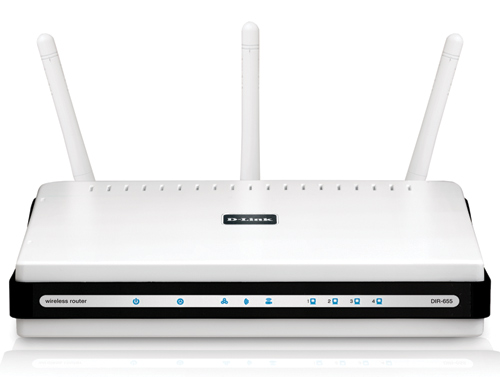
DLINK DIR-655 WiFi router

A popular alternative to using network cables is wireless. Wireless network is convenient and easy to install, especially for existing home where it is difficult to lay new cables. Many consumers prefer to rely on wireless technology for their network services. Wireless tends to use more power and have limitation in the coverage they can support. The wireless signal can cover a distance of 30-50m under open space. The signal will find it hard to penetrate Singapore HDB flat, reducing the distance to about 10-15m. Many of my neighbors are also using WiFi in their home. At the time I am writing now, my WiFi dongle is able to detect 36 WiFi station. WiFi has a limited bandwidth over the air medium. With this limited channels across the air sharing with sharing with the desktop and laptop, the communication can be slow and drop connection can often occurred. There is also a higher possibility of being hack, compared to wired network. As far as possible, physical cable is still my preferred choice.

There are reports which indicate that wireless can cause health hazard. For consumers who are sensitive to radio frequency exposures, they may find it more comfortable with wired network. The same theory applies to the cellular phones. Many research have been produced with respect to these danger.

Health: A Cancer Muckraker Takes on Cell Phones

For me, I do still use it, but will try as much as possible to avoid it.


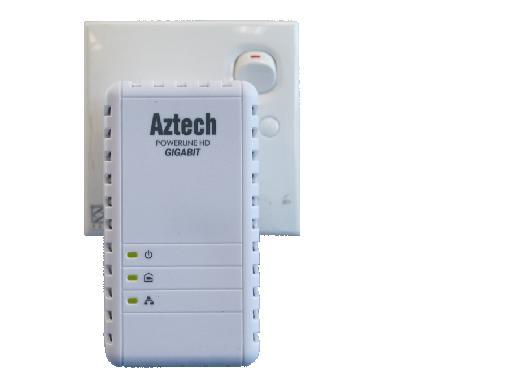
Aztech power line communication modem


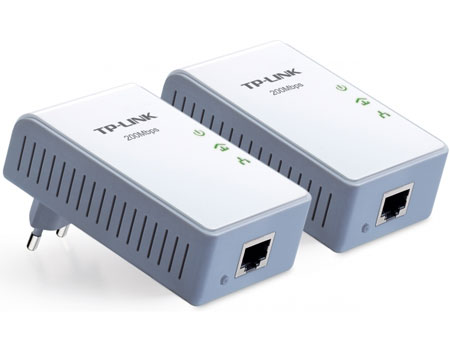
TP-LINK PLC modem

Power line communication is also a popular choice. The network communication is done with the house existing power line. The communication is done within the home power line. Similar to WiFi, it is useful if it is troublesome to lay new wiring.

Wired ethernet network is still the best.


RF

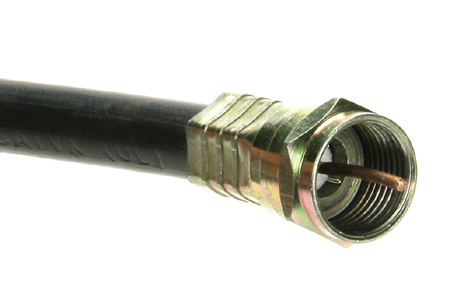
RG6 F81 (F type connector)

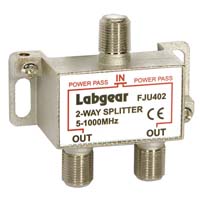
RF splitter (1 in, 2 out)

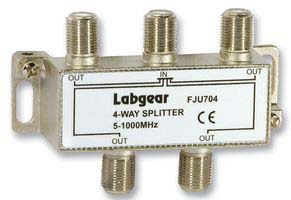
Multi RF spliter(1 in, 4 out)

F type cable

try not to split more than 2 split.

centralised multiple split is preferred, in case any thing happen in future, it is simpler to reticfied.

don’t have to over tighten the connector to the socket.

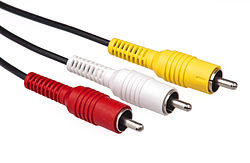
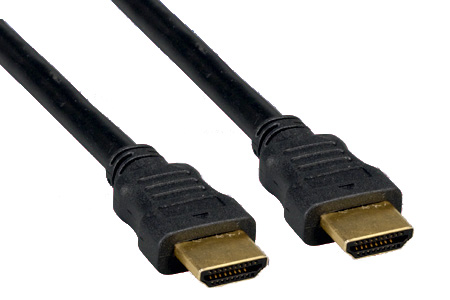
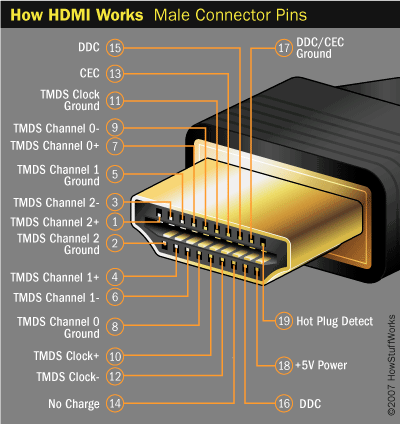
Video/Audio analog signal or HDMI cables

RCA max distance, HDMI ma distance


Smart Features  


www.pic-control.com, Singapore Network Ethernet WiFi RS232 RS485 USB I/O Controller


Green and Efficient  


Useful Home Gadgets

Devices that make your home look smart.

 
available from saveone

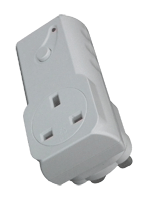
Remote on/off applicances using any IR handheld remote controller.

Application: Using your TV remote control to switch all other entertainment system to save on the standby power consumption.

Using your TV remote control to switch on your wall plugged electrical fan or lamp.

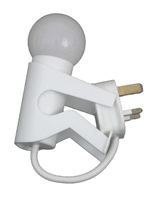
available from saveone Night lamp, which automatically glows in the dark.
available from saveone

Digital timer to on and off appliances.

Able to select individual day/time in a week to on/off appliance.

Switch on network router or entertainment system during the day and switch them off at night. Switch on boiler or cooker at a particular time of the day, so that you can enjoy on time when you can back from work.

available from saveone

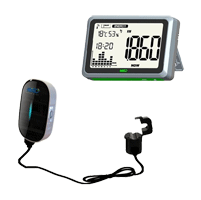
Wireless Power Monitoring.

Monitoring your home energy usage wirelessly.


www.pic-control.com, Singapore Network Ethernet WiFi RS232 RS485 USB I/O Controller


Keyword: Smart home, home automation, intelligent home, DIY smart home, affordable, efficient. Simple and easy to use Singapore home.

Remote Detector Notification System

Protect what matters most — anytime, anywhere.

The Remote Detector Notification System is a smart security solution that instantly detects unauthorized movement and alerts your team in real time. Whether it’s at a jetty, warehouse, factory, or restricted zone, this system ensures you never miss a threat.

Remote Notification System Architecture

Smart Perimeter Security with Instant Alerts

The Remote Detector Notification System is designed to safeguard sensitive areas such as jetties, company boundaries, and other high-security zones. Using motion detection and instant notification technology, the system ensures authorized personnel are alerted the moment an intrusion occurs.


✅ Why Choose Our System?

  • Instant Alerts – Get notified the moment motion is detected.
  • Multi-Channel Notifications – SMS, WhatsApp, Telegram, or Email.
  • Up to 10 Recipients – Alert your whole security team at once.
  • Customizable Messages – Set your own words for every alert.
  • Reliable Hardware – PIR sensor, blinker, and siren integration.
  • Cloud-Ready – Manage, monitor, and update remotely.
  • Flexible Power – AC input, battery backup, and solar panel options.

🌟 Perfect For

  • Coastal security & jetties
  • Industrial facilities
  • Warehouses & storage yards
  • Remote locations without CCTV
  • Perimeter protection for restricted zones

💡 Key Benefits

  • Simple – Easy to set up and operate.
  • Scalable – Add more users and locations as needed.
  • Cost-Effective – Low monthly subscription fees.
  • Future-Proof – Cloud-based design adapts to new messaging apps.

🔍 How It Works

Control – Adjust settings anytime via cloud software.
Detect – PIR sensor picks up intruder movement.
Deter – Siren and blinker activate instantly.
Notify – Customized alerts sent to your team’s phones.

  1. PIR Sensor Detection
    • The Passive Infrared (PIR) sensor detects movement across the secured boundary.
  2. Alarm Activation
    • Connected blinker and siren trigger immediately to deter intruders.
  3. Notification Delivery
    • The system sends a customized message alert to up to 10 mobile numbers, notifying personnel on duty.
    • Flexible options also include Email, Telegram, WhatsApp or SMS notifications.
  4. Cloud Software Control
    • Remote configuration and monitoring through a simple user interface (Google Sheet).
    • Allows customisation of recipient contact numbers, customizing SMS content, and checking device status.

⚙️ Key Features

  • Multi-Channel Notifications: SMS, Email, Telegram, WhatsApp.
  • Customizable Alerts: Define your own notification messages.
  • Scalable Setup: Supports up to 10 personnel at a time.
  • Cloud-Based Control: Manage system settings remotely.
  • System Status Monitoring: Check if the system is operating and connected online.
  • Flexible Power Options: AC power input, battery UPS, and optional solar panel integration.
  • Strong Connectivity: 3G/4G/5G modem with Ethernet/WiFi support.
  • Security Hardware Integration: Compatible with existing PIR sensor, blinker, and siren.

📦 Package Includes

  • Sensor Controller (with battery backup)
  • 3G/4G Modem
  • Cloud Software Development & Hosting
  • Enclosure
  • 1-Year Warranty & Support

Optional Monthly Fees

  • Network SIM Card (4G): Estimate about $10/month
  • WhatsApp Alerts (est.): Estimate about $10/month
  • SMS Alerts (est.): Estimate about $10/month
  • Email & Telegram Alerts: Free

Contact Us

Click here to contact us for more details.

⚙️ PIC‑WEB32: Industrial Ethernet Dry Contact Controller for Seamless I/O Integration

Web I/O 32 digital input output

The PIC‑WEB32 is a high-performance Ethernet I/O controller purpose-built for industrial and automation environments where stable, networked dry contact control is essential. Featuring a rugged, fanless aluminum enclosure and wide operating tolerances, the PIC‑WEB32 integrates easily into existing infrastructure with both web-based management and enterprise-level protocol support.

Engineered with IP40-rated protection and designed for DIN-rail or wall mount installations, this versatile controller ensures consistent operation under harsh electrical and environmental conditions.


🌐 Network-Ready for Smart Control Applications

Featuring pluggable terminal connection for easy connection.

With support for 32 digital input/output (I/O) channels, the PIC‑WEB32 delivers precise, low-latency relay control. Each I/O can function as a dry contact or pulse-enabled wet contact interface, making the unit adaptable for a wide range of automation and remote monitoring scenarios.

Equipped with two independent Ethernet ports (10/100 Mbps), the controller supports dual MAC and IP addresses, offering network redundancy or segmentation for mission-critical operations.

Whether for smart buildings, legacy equipment bridging, alarm management, or SCADA systems, the PIC‑WEB32 streamlines Ethernet-based I/O expansion across your facilities.


🔧 Key Technical Features

  • Processor & System:
    Industrial-grade ARM9 processor @300 MHz running embedded OpenWRT Linux for stability and upgradability.
  • Ethernet & Protocols:
    • Dual 10/100 Mbps ports with Auto-Negotiation & Auto-MDIX crossover detection
    • Protocol support includes: Modbus TCP, TCP/UDP Server & Client, HTTP, SNMP, Telnet, SSH
  • Digital Input/Output:
    • 32 independently configurable I/Os
    • Dry and wet (pulse) contact supported
    • Status LEDs for each I/O line
  • Management Interfaces:
    • Accessible via Web GUI, Telnet, SSH, and Windows configuration utility
    • SNMP supported for enterprise monitoring systems
  • Power Supply:
    • Accepts wide voltage range: DC 12–55V or AC 12–40V
    • Built-in surge, overload, and reverse-polarity protection
    • Supports redundant power input
  • Mechanical & Environmental:
    • IP40 anodized aluminum casing
    • DIN-rail or wall mount compatible
    • Fanless, passive cooling for noise-free operation
    • Operating Temp: −40°C to +85°C
    • Humidity: 0–95% RH (non-condensing)
  • MAC & Interface Standards:
    • Fully compliant with IEEE 802.3 Ethernet standards
    • RJ45 connectors with dynamic MAC address learning

🧩 Where It Fits In

The PIC-WEB32 is ideal for systems where networked dry contact inputs/outputs are needed with high reliability:

  • 🏢 Building automation
  • 🚨 Alarm trigger systems
  • 🏭 Factory floor control panels
  • 🌐 Remote I/O over TCP/IP
  • 🧠 Intelligent relay expansion for PLCs or SCADA systems

Setup Connection

These are some illustration of a typical connection setup.

Typical connection setup for a single server
Paired server setup connection

💬 What Customers Say

“We were able to migrate our legacy relay panels into a smart Ethernet system with the PIC‑WEB32. Reliable, compact, and easy to manage.”
— Systems Engineer, Building Infrastructure Solutions

“Plugged it into our Modbus TCP network and had all contact signals online in minutes. Excellent industrial controller.”
— Automation Manager, Precision Manufacturing


✅ Contact Us

Experience the power of streamlined industrial control with the PIC‑WEB32.
👉 Contact Us Today

-> Click here for PIC-WEB32 product brochure.

Other Similar Products

PIC-WEB16
PIC-WEB08