Choosing the Right Controller for PS-5R Water Level Sensor Rods
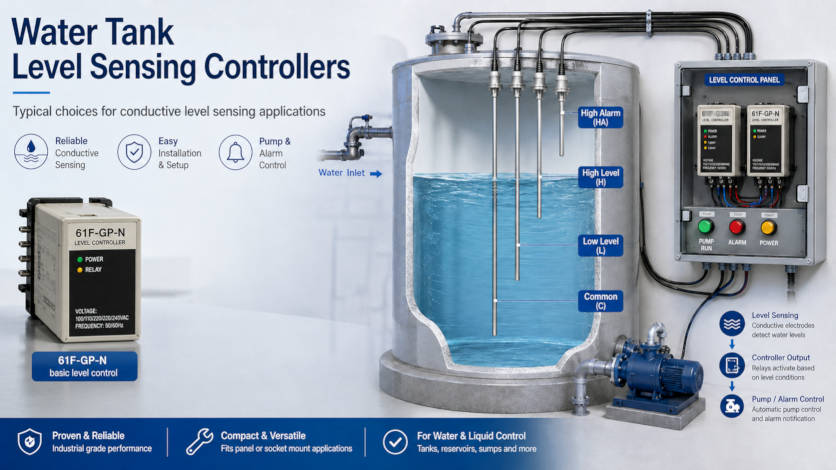
The PS-5R electrode holder is used together with a conductive / floatless water level controller. The electrode rods detect water contact, while the controller converts that signal into relay output for pump control, high level alarm, low level alarm, or level indication.
✓ Water tank level sensing
✓ Pump control
✓ High / low level alarm
✓ Conductive liquid sensing
PS-5R Is the Sensor Holder — The 61F Is the Controller
A common misunderstanding is to treat the PS-5R as a complete water level sensor system. In actual use, the PS-5R is the electrode holder and rod assembly. It needs a compatible controller such as the Omron 61F series to operate the relay output.
1. Electrode Holder
PS-5R
Holds up to 5 electrode rods. The rods are cut to different lengths according to the required water levels.
2. Controller
61F Series
Detects the conductive path through water and provides relay output for control, alarm, or indication.
3. Output Device
Pump / Alarm
The controller output can drive a contactor, pump starter, alarm lamp, buzzer, PLC input, or BMS input.
Most Common Controller Choices
For most PS-5R water level applications, customers usually choose between a basic controller such as 61F-GP-N and a multi-level controller such as 61F-G3N.
Basic Level Control
61F-GP-N
Choose this when you only need simple water level control, such as pump ON/OFF between two levels or a single high/low level alarm.
- Suitable for simple tank level control
- Good for 1 or 2 level points
- Compact plug-in type controller
- Common choice for basic pump start/stop applications
- Cost-effective for simple control panels
Multi-Level Control + Alarm
61F-G3N
Choose this when you need pump control together with high and low water level alarm points. This is usually the better choice for fire water tanks, service tanks, and applications where multiple level signals are required.
- Suitable for multiple level points
- Can support pump control plus high/low level alarms
- Cleaner setup than using multiple basic controllers
- Recommended for 3-level fire water tank monitoring
- Better for control panels with alarm outputs
61F-GP-N vs 61F-G3N: Which One Should You Use?
| Selection Point | 61F-GP-N | 61F-G3N |
|---|---|---|
| Best for | Simple level control | Pump control with high / low alarm |
| Typical number of level points | 1 or 2 level points | 3 or more level functions depending on wiring and application |
| Typical application | Basic tank full/empty control, pump start/stop, simple high or low alarm | Fire water tank, service water tank, refill tank, tank with high alarm and low alarm |
| When to choose | Choose when the customer only needs basic pump ON/OFF or one simple alarm output | Choose when the customer needs more complete monitoring, such as high level, refill control, and low level alarm |
| Panel design | Smaller and simpler panel. Suitable for basic applications | More complete control panel. Suitable when alarm points must be clearly separated |
| Recommended for PS-5R? | Yes, for simple applications using only some of the rods | Yes, especially when using PS-5R for multi-level monitoring |
| Simple recommendation | Use this for basic tank control | Use this for fire water tank / 3-level monitoring |
Typical 3-Level Fire Water Tank Setup
For a fire water tank, a typical setup uses one common electrode and several level electrodes. The common electrode is normally the longest rod. The other rods are cut to the required alarm and control levels.
| Electrode Level | Function | Typical Action |
|---|---|---|
| High Alarm | Detects overfill or high water condition | Trigger high level alarm, indicator lamp, BMS input, or alarm panel input |
| Stop Refill | Normal full level | Stop refill pump or close inlet valve |
| Start Refill | Normal low operating level | Start refill pump or open inlet valve |
| Low Alarm | Low water reserve warning | Trigger low level alarm, fire alarm monitoring input, or BMS input |
| Common Electrode | Reference electrode | Usually the longest rod, extending below the lowest detection point |
Practical recommendation: For a 3-level fire water tank application, use the PS-5R electrode holder together with a multi-level controller such as 61F-G3N. This gives a cleaner solution for refill control plus high and low level alarm.
How to Select the Correct 61F Controller
Step 1: Count the Required Levels
If you only need simple pump ON/OFF, 61F-GP-N is usually enough. If you need high alarm, normal control, and low alarm, use 61F-G3N.
Step 2: Check Cable Distance
If the tank is far from the control panel, a long-distance version may be required. This is important for rooftop tanks, remote tanks, and large facilities.
Step 3: Check Water Conductivity
Conductive level controllers require the liquid to conduct electricity. Normal tap water is usually suitable, but very clean or low-conductivity water may need a high-sensitivity model.
Other 61F Variants You May See
Besides the normal general-purpose models, 61F controllers may also come in special versions depending on site conditions.
| Variant Type | Meaning | Use When |
|---|---|---|
| General-purpose | Standard model for normal conductive water level control | Normal tap water, tank control, refill pump control |
| Long-distance type | Designed for longer wiring distance between tank electrodes and controller | Tank is far away from the control panel |
| High-sensitivity type | More sensitive detection for lower-conductivity liquid | Clean water, rainwater, purified water, or weakly conductive liquid |
| Low-sensitivity type | Less sensitive to leakage current, condensation, foam, or wet cable paths | Noisy environments or sites with false triggering problems |
| Two-wire type | Special wiring method for reducing electrode wiring | Use only when matched with the correct two-wire electrode holder / application |
Quick Recommendation
Choose 61F-GP-N if…
- You need simple water level control.
- You only need pump ON/OFF between two levels.
- You only need one high or low level alarm.
- You want a compact and cost-effective controller.
Choose 61F-G3N if…
- You need 3-level water tank monitoring.
- You need pump control plus high and low alarms.
- You are monitoring a fire water tank or service water tank.
- You want a cleaner solution than using multiple basic controllers.
Important note for fire water tanks: Fire water tank alarm and control requirements may be subject to project specifications, local authority requirements, fire code requirements, and licensed fire protection contractor approval. Always confirm the final control logic and alarm connection with the project consultant or qualified contractor.
Need Help Choosing the Correct Water Level Controller?
Tell us your tank application, number of level points, cable distance, water type, and required output such as pump control, high level alarm, low level alarm, PLC input, or BMS input. We can help recommend a suitable controller setup for use with PS-5R electrode rods.